

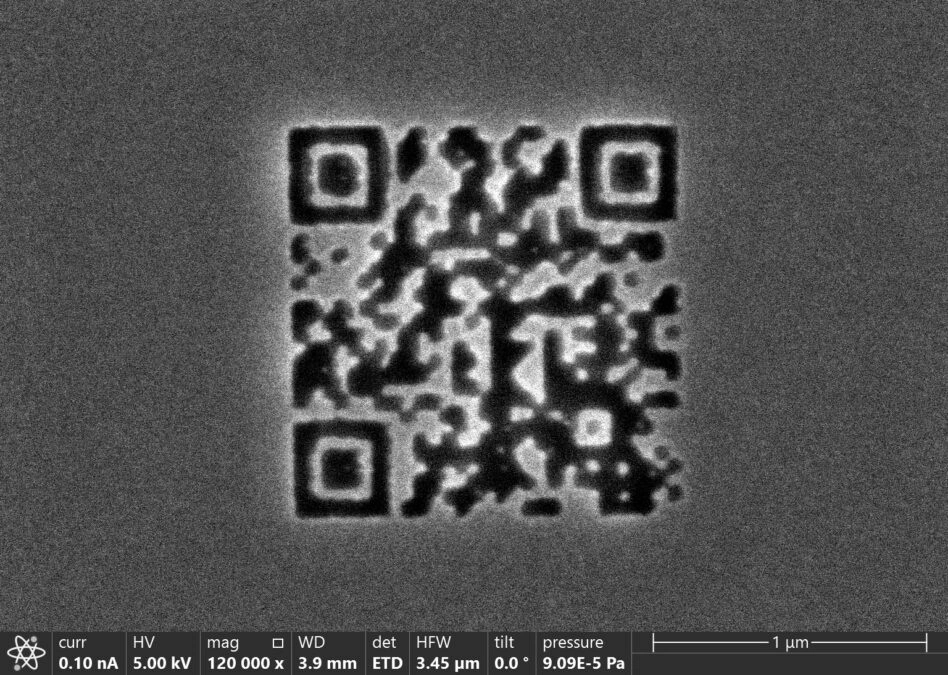
Researchers have developed what is believed to be the smallest QR code ever produced, a microscopic structure so tiny that scanning it would require an electron microscope rather than a smartphone camera.
The code occupies an area of just 1.977 square micrometers — smaller than some bacterial cells and even certain particles of air pollution. The achievement secured the seven-member research team a place in the Guinness World Records, as the new QR code is roughly three times smaller than the previous record holder.
The project was led by scientists at TU Wien in collaboration with the data-storage technology company Cerabyte. According to materials scientist Paul Mayrhofer, the code’s structure is so finely detailed that it cannot even be observed using a conventional optical microscope.
Nanotechnology Meets Data Storage
To create the microscopic code, researchers engraved it onto an ultra-thin ceramic film typically used to coat high-performance cutting tools. Using focused ion beams, they produced QR pixels measuring just 49 nanometers — about ten times smaller than the wavelength of visible light.
This means the code is effectively invisible to the human eye while still remaining technically readable under the appropriate analytical equipment.
Beyond the record itself, the development could have broader implications for ultra-durable data storage technologies. As materials scientist Alexander Kirnbauer explains, the concept resembles ancient methods of preserving information by engraving it onto stable materials designed to withstand the passage of time.
Researchers estimate that, using this approach, more than 2 terabytes of data could theoretically be stored on a surface the size of an A4 sheet. In addition, ceramic-based storage may offer a lower environmental footprint compared with many current digital storage technologies.
In other words, an innovation created at the nanometer scale could eventually influence how humanity preserves digital information for the long term.