
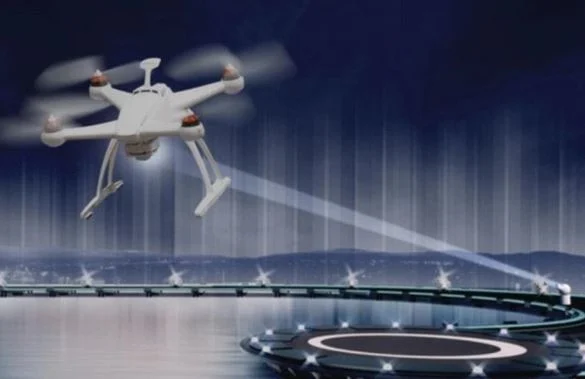
Limited battery life remains one of the biggest challenges facing drones. Researchers in China have now developed a technology that could dramatically extend flight times by wirelessly delivering power to drones in midair using laser beams.
The prototype system, developed by scientists from the Civil Aviation University of China and Tsinghua University, employs a specialized photovoltaic receiver mounted beneath a drone’s wing. The device converts laser energy directly into electricity, providing power to the aircraft’s propulsion system during flight.
The study was published in the journal Matter & Light.
How the technology works
At the heart of the system is a perovskite laser thermoelectric (PLC-TE) device designed to convert laser light into electrical energy with high efficiency.
Perovskite materials are considered among the most promising candidates for next-generation solar technologies because they absorb a broader range of light wavelengths than silicon while delivering outstanding photovoltaic performance.
During testing, the receiver converted 38.49% of the incoming green laser energy into electricity. According to the researchers, this exceeds the previous efficiency benchmark reported for hybrid perovskite-silicon photovoltaic cells.
Solving the heat problem
Early experiments revealed a major obstacle: the high-power laser caused the receiver to overheat, significantly reducing its performance.
“When we tested the device under high-power laser illumination, thermal imaging showed temperatures reaching 80 to 90 degrees Celsius much higher than expected. That made us realize heat accumulation was a far more serious engineering challenge than we had anticipated,” said lead author Jianhua Han.
To address the issue, the researchers incorporated antimony triselenide nanocrystals into the device. These semiconductor nanomaterials act as thermal barriers, limiting heat transfer and preventing excessive temperature buildup. In addition, airflow generated by the drone’s propellers helps cool the receiver during flight.
Extending flight time
The technology has the potential to dramatically increase drone endurance by reducing the need for frequent landings and battery replacements.
“Imagine drones inspecting forests, monitoring disaster zones, or delivering supplies without having to interrupt their missions for battery charging. As drone operations become longer and more demanding, battery life remains one of the greatest limitations,” Han explained.
The researchers believe the system could eventually support applications including aerial surveillance, infrastructure inspection, cargo transport, environmental monitoring, and disaster response.
The next stage
Although the proof of concept results are encouraging, several engineering challenges remain before the technology can be deployed in real world conditions.
One of the most important is developing high-precision tracking systems capable of continuously keeping the laser beam aligned with the drone’s receiver throughout flight.
The team’s next objective is to test the technology on a lightweight operational drone under outdoor conditions.
Wireless laser power transmission has attracted growing international interest from both industry and defense organizations. If successfully commercialized, it could enable surveillance, reconnaissance, and cargo drones to remain airborne far longer than current battery technology allows.
Research in this field is advancing rapidly. In 2025, the U.S. Defense Advanced Research Projects Agency (DARPA) transmitted 800 watts of electrical power wirelessly over a distance of 8.6 kilometers through its Persistent Optical Wireless Energy Relay (POWER) program. Meanwhile, companies such as PowerLight Technologies are developing high-power laser energy transmission systems capable of supplying drones operating at altitudes of up to 1,500 meters.