
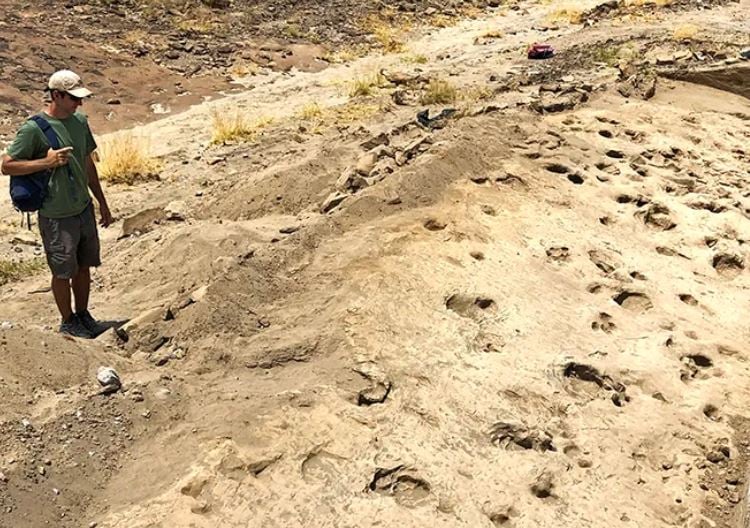
Scientists have identified the first confidently attributed fossil footprints of Paranthropus boisei, an extinct member of the human evolutionary lineage. The 1.43-million-year-old tracks, discovered on the muddy shoreline of an ancient lake in northern Kenya, provide unprecedented insights into the body size, locomotion, and possible social behavior of one of humanity’s closest extinct relatives.
Paranthropus boisei was the last known species of the genus Paranthropus and is best known for its remarkably robust skull and exceptionally large teeth—adaptations believed to reflect a diet rich in tough vegetation. Until now, however, scientists knew relatively little about the rest of its anatomy or how it behaved.
Evidence of a group moving together
Researchers identified 21 footprints belonging to at least eight individuals that appear to have walked together across a muddy lakeshore near Lake Turkana.
Based on foot morphology, stride characteristics, and gait, the team concluded that the tracks were made by Paranthropus boisei. Their size also suggests they were most likely left by adult males.
“This is another remarkable snapshot that helps us understand what these hominins looked like, how they moved, and how they interacted with one another and with their environment,” said lead author Kevin Hatala, a paleoanthropologist at Chatham University and the Max Planck Institute for Evolutionary Anthropology. The study was published in the Proceedings of the National Academy of Sciences (PNAS).
Larger than previously thought
Until now, Paranthropus boisei had been known mainly from fossil skulls and teeth. The newly discovered footprints provide the first reliable estimates of the species’ body size.
According to the researchers, some individuals may have reached heights of up to 1.83 meters (6 feet) and weighed around 75 kilograms, making them considerably larger than previously assumed and approaching the body size of Homo erectus.
“For many years we believed Paranthropus boisei was substantially smaller than Homo erectus. These footprints suggest it may have achieved similar body size despite having very different dietary adaptations,” Hatala explained.
Clues to social behavior
The footprint pattern indicates that the eight individuals repeatedly moved toward and away from the lakeshore, walking through shallow water.
Researchers cannot determine exactly what they were doing. They may have been searching for food or water, conducting some form of territorial patrol, or simply traveling together.
One intriguing possibility is that the tracks represent an all-male group, similar to bachelor groups observed in modern gorillas after males leave their natal family groups.
If correct, this would provide the first direct evidence that Paranthropus boisei formed stable groups of males capable of coexisting peacefully.
A new window into human evolution
The footprints were dated using volcanic ash layers preserved within the surrounding sediments. The site also yielded tracks from hippopotamuses, antelopes, shorebirds, and other animals, offering a detailed picture of the ecosystem inhabited by these early hominins.
Previous research has shown that Paranthropus boisei lived alongside Homo erectus, a species considered a close ancestor of modern humans. Researchers suggest that competition for food, together with climate driven environmental changes, may have contributed to the extinction of Paranthropus boisei around 1.2 million years ago.
The discovery represents the first definitive footprint evidence for the species, providing rare insights not only into its anatomy but also into its movement and possible social organization, significantly expanding our understanding of human evolution.