

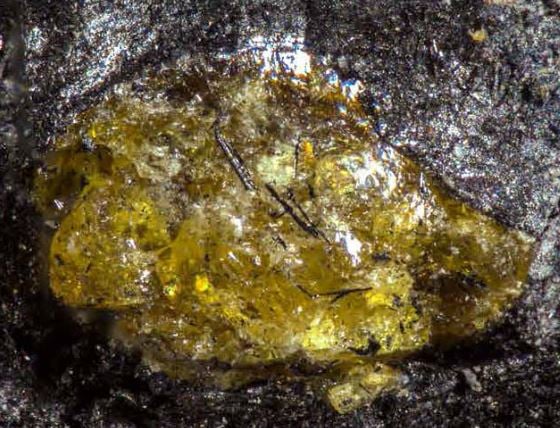
Paleontologists in China have uncovered what is believed to be the oldest confirmed amber ever discovered, pushing back the known origin of fossilized plant resin by around 65 million years. The remarkable find dates to approximately 385 million years ago, during the Middle Devonian Period, and suggests that resin producing biochemical pathways evolved long before the emergence of seed plants.
A window into earth’s ancient past
Amber is fossilized plant resin produced as a natural defense against injuries, fungal infections, parasites, and other environmental threats. Over millions of years, the resin hardens and fossilizes, often preserving organisms and other traces of ancient ecosystems, making amber one of the most valuable archives of prehistoric life.
“Amber represents one of nature’s most important time capsules, preserving geological, biological, and environmental information from ancient terrestrial ecosystems,” said Dr. Zhihang Luo of the Nanjing Institute of Geology and Palaeontology, Chinese Academy of Sciences, and the Senckenberg Natural History Museum.
How the discovery was made
The research team examined approximately 10 kilograms of coal collected from the Hujiersite Formation near Hoxtolgay in China’s Xinjiang region. Using ultraviolet light, the scientists identified tiny concentrations of amber embedded within the coal and manually extracted 241 microscopic fragments under a microscope, most measuring only 0.1 to 0.5 millimeters across.
The amber ranges from translucent to opaque, with colors varying from pale yellow to dark brown. Several fragments contain tiny bubbles and display an intense blue fluorescence when exposed to ultraviolet light.
Dating of the surrounding geological layer confirmed an age of about 385 million years, making the material the oldest chemically confirmed amber ever identified and surpassing the previous oldest record by roughly 65 million years.
Chemical analysis reveals an unexpected origin
Using Fourier-transform infrared spectroscopy (FTIR) together with gas chromatography-mass spectrometry (GC-MS), researchers analyzed the fossil resin’s chemical composition.
Surprisingly, its chemistry closely resembles the resin produced by modern and extinct conifers. However, when this resin formed, seed plants had not yet evolved.
The researchers propose that the resin was likely produced by progymnosperms or tree-like lycopsids ancient groups of seedless vascular plants whose fossils have also been recovered from the Hujiersite Formation. Although the exact source cannot yet be confirmed, the findings indicate that complex resin-producing pathways had already evolved in seedless plants.
Rethinking the evolution of plant resin
The study suggests that the biochemical machinery required to synthesize terpene-rich resins originated in seedless plants during the Middle Devonian, much earlier than previously believed.
According to the researchers, this ancient resin most likely evolved to seal wounds and protect plants from fungal infections rather than defend against insect herbivores, since the earliest clear evidence of plant-feeding insects appeared later during the Carboniferous Period. Frequent wildfires during the Devonian may also have played an important role in driving the evolution of these protective resins.
The scientists conclude that Hujiersite amber is currently the oldest chemically verified amber known to science. If its seedless-plant origin is confirmed, the discovery will significantly reshape current understanding of when and in which plant lineages resin production first evolved on Earth.