
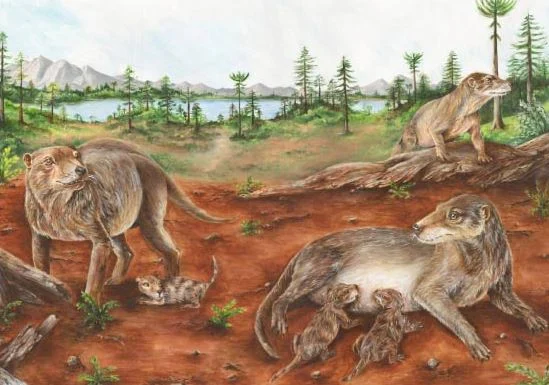
A 236-million-year-old fossil may reshape our understanding of the origins of live birth and the early evolution of mammals. Paleontologists studying the remains of an ancient animal from what is now Argentina have found evidence suggesting that it gave birth to live young, pushing the emergence of this reproductive strategy back by as much as 90 to 95 million years.
Live birth, or viviparity, is considered one of the major evolutionary innovations associated with the history of mammals. While egg-laying is regarded as the ancestral reproductive strategy among vertebrates, viviparity has evolved independently more than 150 times across different vertebrate groups.
Modern animals that give birth to live offspring possess a complex set of interconnected traits, including placental development, lactation, and hormonal regulation. According to the researchers, these features point to viviparity as an important evolutionary transition within the lineage leading to mammals.
A cynodont from the Triassic Period
The research team, led by paleontologist Leandro Gaetano of Argentina’s National Scientific and Technical Research Council (CONICET), examined fossil remains of Chiniquodon theotonicus. The animal was a cynodont, a mammal-like creature that lived during the Triassic Period and was roughly the size of a cat. Its fossils were discovered in what is now northwestern Argentina.
Researchers examined thin sections taken from the animal’s femur and ulna. Inside the bones, they identified a distinctive transition in the bone tissue near the center of each bone. This feature, known as a “neonatal line,” is associated with birth and has been documented in modern mammals.
What makes the discovery particularly significant is that such a feature had never previously been identified in such an ancient, non-mammalian relative of mammals.
From 1.68 kilograms at birth to nearly 12 kilograms as an adult
Using measurements of the bone at the location of the neonatal line, the researchers estimated that the animal weighed approximately 1.68 kilograms at birth and nearly 12 kilograms as an adult.
The newborn therefore weighed roughly 10% to 20% of its eventual adult body mass. That proportion is considerably closer to what is seen in modern placental mammals than to the patterns found in egg-laying reptiles and birds. It also differs from marsupials and monotremes, whose newborns are generally much smaller relative to their eventual adult size.
The evidence points toward mammals
To test their hypothesis, the researchers carried out a statistical analysis comparing the fossil with nearly 1,900 mammal species, 2,600 reptile species, and 780 bird species.
The Chiniquodon theotonicus data consistently clustered with placental mammals, strengthening the possibility that its reproductive strategy resembled that of later mammals.
“For the first time, we show that live birth was present in at least one mammalian ancestor, Chiniquodon theotonicus, which lived approximately 236 million years ago,” Gaetano said. The finding suggests that viviparity among early cynodonts emerged at least 90 to 95 million years earlier than previously thought.
Was live birth an ancient evolutionary innovation?
The discovery challenges the long-standing assumption that all non-mammalian cynodonts laid eggs and that live birth evolved only once, later in the mammalian lineage that eventually gave rise to modern placental mammals and marsupials.
The researchers outline two possible evolutionary scenarios.
Under the first, live birth evolved independently along the lineage of Chiniquodon theotonicus and later emerged again in other groups. Under the second, viviparity evolved only once, very early in mammalian evolutionary history, while today’s egg-laying monotremes, such as the platypus, represent a later evolutionary return to the ancestral strategy of laying eggs.
The researchers stress, however, that additional fossils and independent evidence will be needed to determine which scenario is correct.
“It is very likely that Chiniquodon theotonicus is not an isolated case of viviparity among cynodonts,” Gaetano said. The fossil could instead represent evidence of a broader transition from egg-laying to live birth that began much earlier in mammalian evolutionary history.
If future discoveries confirm the hypothesis, they could reveal that some of the earliest mammalian relatives had already developed reproductive characteristics that made them far more similar to modern mammals than previously recognized.