

Smell is one of the most powerful yet least understood human senses. It shapes how we experience food, warns us of danger, triggers memories, and even signals changes in the environment around us. Despite its importance, scientists have long struggled to understand how the sense of smell is biologically organized.
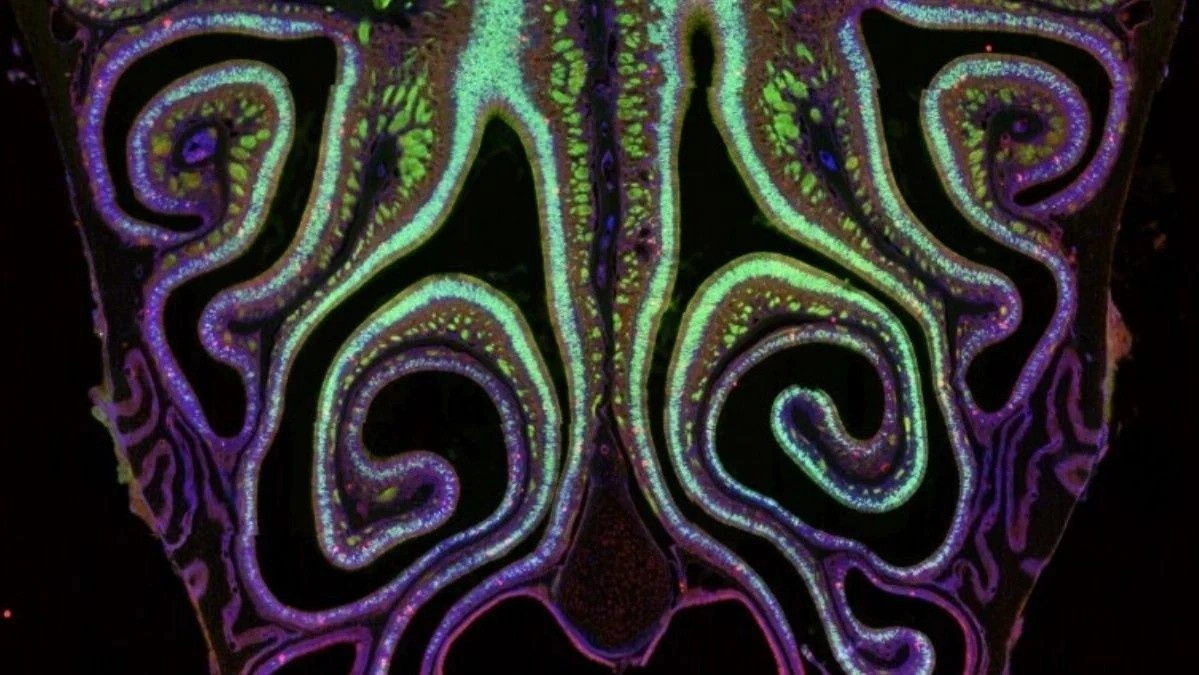
Now, a groundbreaking study published in Cell Press may have changed that. Researchers have created the first detailed “map of smell,” revealing how thousands of odor receptors are arranged inside the noses of mice – a discovery that challenges decades of assumptions about how olfaction works.
“Smell has remained one of the most mysterious senses,” said neuroscientist Sandeep Robert Datta of Harvard University, the study’s lead author. “It was the sensory system that lacked a map for the longest time.”
The research drew on data from more than 300 mice. Scientists genetically analyzed around five million nasal tissue cells, ultimately identifying roughly 2.3 million olfactory sensory neurons – the specialized cells responsible for carrying odor information from the nose to the brain.
Until now, researchers believed these receptors were distributed almost randomly throughout the nasal cavity. The new findings suggest otherwise. Instead, odor receptors appear to follow a highly organized spatial pattern, forming narrow horizontal zones that extend from the top to the bottom of the nasal cavity.
According to the team, this structure is controlled by a shifting “transcriptional code” that precisely organizes the sensory channels responsible for detecting smells.
The researchers also discovered that retinoic acid – a naturally occurring molecule known to regulate gene activity – plays a key role in shaping this arrangement. By experimentally altering retinoic acid levels in mice, the scientists were able to shift the positioning of odor receptor zones inside the nose.
The study further revealed that the organization of receptors in the nose mirrors the structure of the olfactory bulb in the brain, suggesting that the sense of smell relies on a far more ordered neural architecture than previously believed.
Although mice and humans differ significantly, researchers say the findings could eventually help scientists better understand the human olfactory system and pave the way for future treatments for smell disorders.
“Smell has a profound impact on human health and psychological well-being,” Datta said. “We cannot restore the sense of smell unless we first understand how it works at a fundamental level.”