

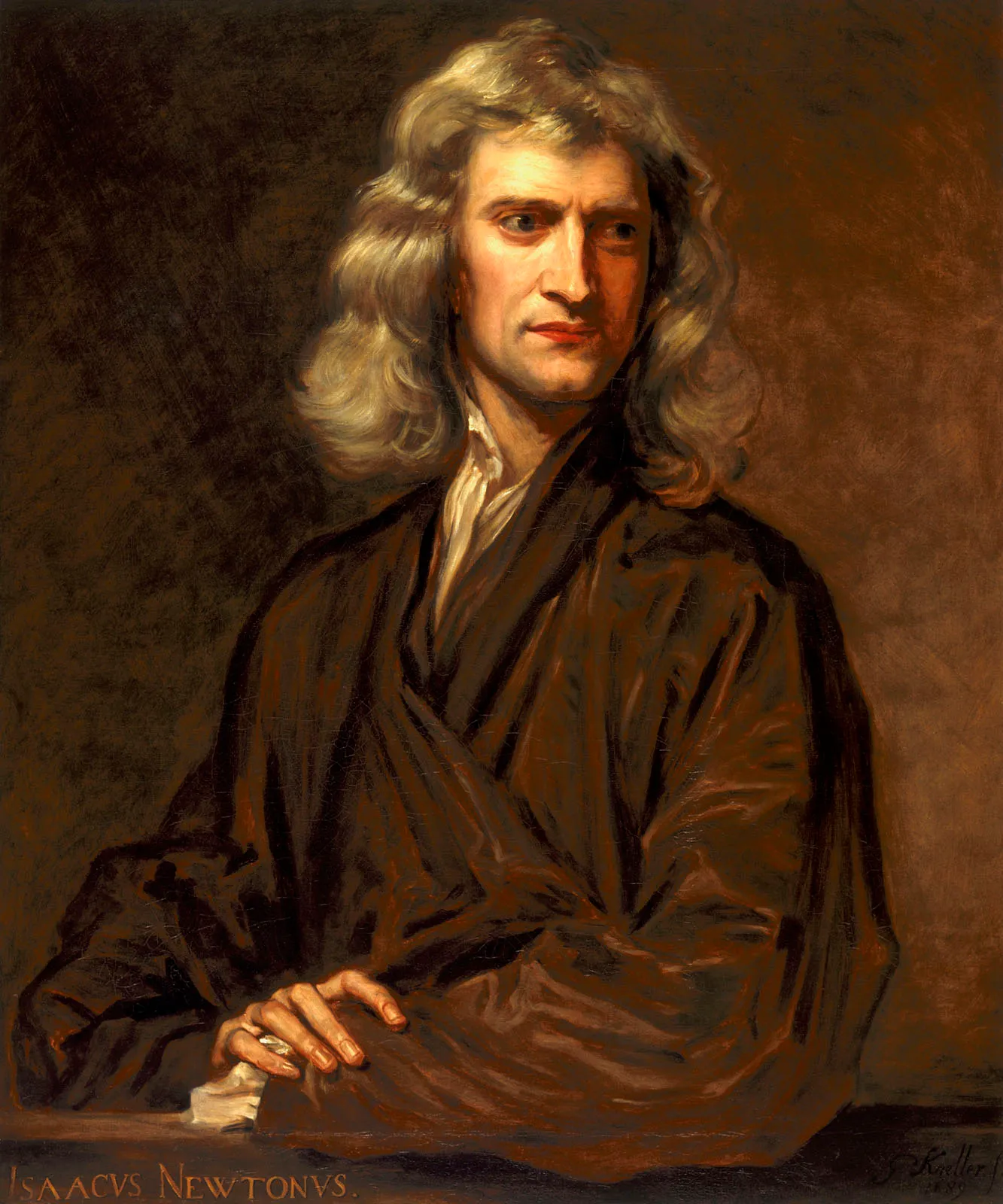
In the history of science, certain figures transcend the boundaries of a single field, serving as bridges between different intellectual worlds. Isaac Newton stands as one of the clearest examples: the founder of classical mechanics and the architect of universal gravitation was also deeply engaged in theology and biblical chronology.
This is where a striking historical paradox emerges. Although Newton helped reveal the vastness of the universe, he did not directly contribute to the concept of geological “deep time.” On the contrary, much of his work sought to align human history with the biblical timeline. In Chronology of Ancient Kingdoms Amended, he used scientific methods not to expand time, but to constrain it within a theological framework.
For Newton, the history of the Earth was inseparable from human history. Geological processes did not require vast spans of time; they could instead be explained through an initial divine creation or occasional interventions. In this view, time was not expanded — it was compressed.
Yet Newton’s influence proved decisive, even if indirectly. By formulating universal laws of nature, he introduced a radically new worldview: a unified, predictable universe governed by mathematical laws. The cosmos was no longer chaotic but orderly, structured by principles that applied everywhere — from the Earth to the stars. This shift allowed infinity to move from philosophical speculation into the realm of science.
Within this framework emerged a crucial distinction that shaped geological thought: the contrast between “time’s arrow” and “time’s cycle.” Newton clearly aligned with the first — a linear, purposeful, and theologically meaningful history. Yet scientific thought would gradually move toward the second.
In Theory of the Earth, James Hutton described a planet with no visible beginning or end, shaped by continuous cycles of uplift, erosion, and renewal. Geological time became not merely vast, but effectively limitless. Charles Lyell later refined this view, explicitly comparing the immensity of geological time to the vastness of space revealed by Newtonian physics.
Here lies the historical paradox: Newton never embraced deep time, yet he helped make it possible. He did not formulate the idea, but he created the intellectual conditions that made it conceivable.
The transition from a world only thousands of years old to one spanning billions was not simply a scientific development. It represented a profound cultural shift — a transformation in humanity’s sense of scale, perspective, and possibility. The recognition of deep time stands among the greatest intellectual revolutions in human history, fundamentally changing how we understand both Earth and ourselves.
Today, humanity is understood as a brief moment within an immense temporal landscape. And behind this transformation stands Newton — not as the one who articulated deep time, but as the quiet prologue to one of the most transformative ideas in science.