
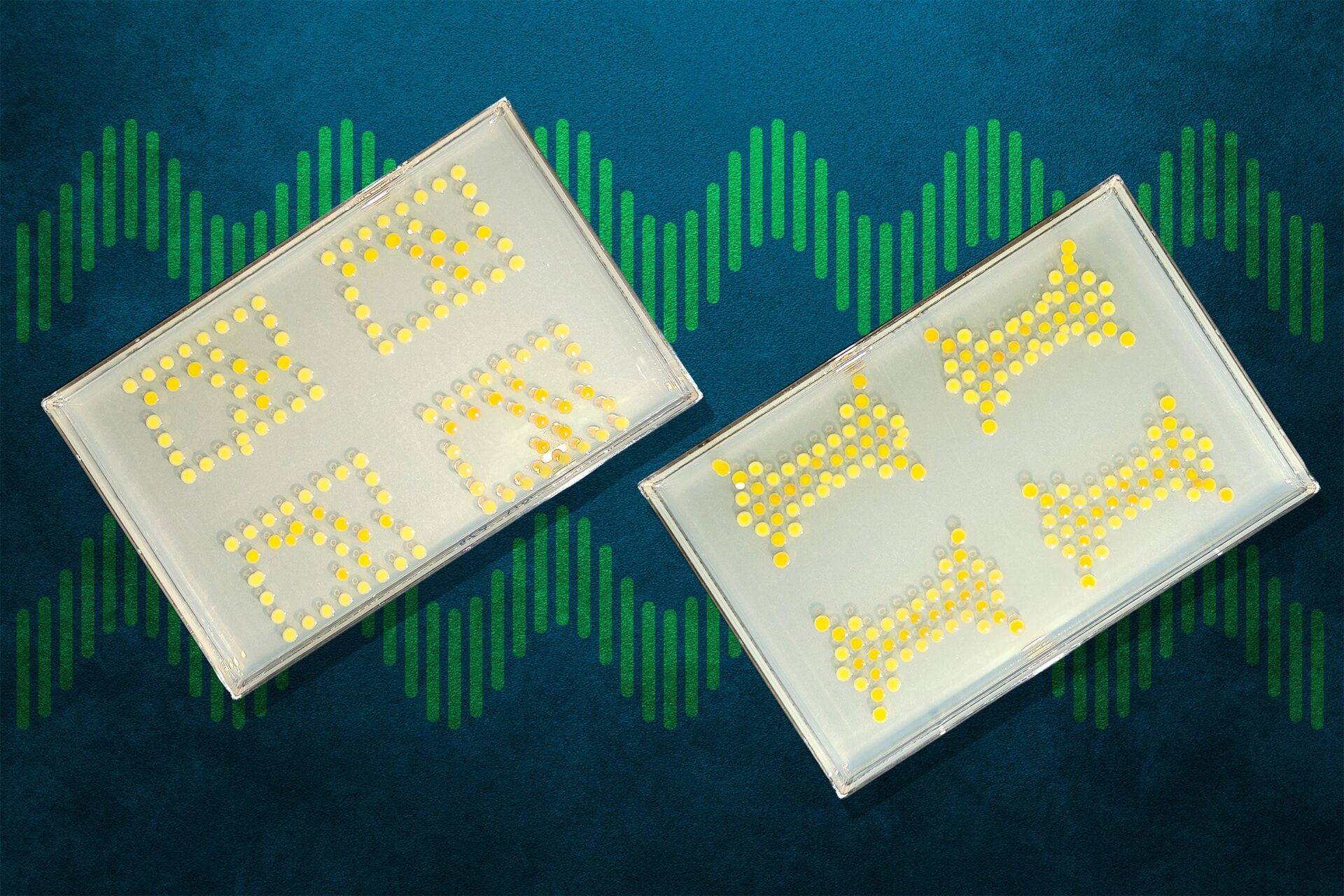
What if a circuit board could be built not from silicon and metal, but from living cells? Researchers at the Massachusetts Institute of Technology (MIT) have taken a step toward that concept by genetically engineering bacteria to perform functions similar to electronic transistors and communicate through chemical signals.
The result is a biological version of a circuit board in which separate bacterial colonies act as individual components, processing information and passing signals from one part of the system to another.
The study, published in Nature Chemical Biology, demonstrates bacterial circuits capable of combining multiple inputs, performing logic operations and directing signals toward different outputs.
Bacteria as biological transistors
In conventional electronics, transistors act as switches, controlling the flow of electrical current through a circuit.
The MIT team translated the same basic concept into biology. Instead of moving electrons, their bacterial components control the movement of small signaling molecules. A colony can therefore receive a chemical input, process it according to its programmed state and generate another signal for the next component.
The researchers engineered two types of bacterial transistors, along with three additional bacterial strains designed to function as signal relays. These components can be assembled in different configurations to create increasingly sophisticated biological circuits.
The system uses Pantoea agglomerans, a bacterium commonly found on plants and environmental surfaces. The two transistor variants respond differently to a molecule known as OC-6. One is switched on when the molecule is present, while the other is switched off.
The bacteria can also detect a second molecule, OC-12. Depending on the state of the circuit, they produce another signaling molecule, OHC-14, allowing information to move to the next stage.
Chemical signals rReplace wires
One of the most innovative aspects of the approach is how the researchers connect the biological components.
Traditional synthetic-biology circuits often place multiple functions inside a single cell. As circuits become more complex, however, their components can interfere with one another or compete for the cell’s limited resources.
The MIT researchers took a different approach. Rather than placing the entire system inside one cell, they assigned individual functions to separate bacterial populations effectively turning each colony into a component of a larger biological circuit.
Three additional Pantoea agglomerans strains were engineered as signal relays. Their job is to convert OHC-14 into another chemical signal that can be detected by the next bacterial component.
The colonies were printed onto agar plates and positioned roughly five millimeters apart. This spacing helps prevent the chemical signals from spreading indiscriminately, creating controlled communication pathways between neighboring colonies.
In this biological architecture, chemical molecules take the place of electrical signals, while bacterial colonies perform the roles normally handled by electronic components.
From logic gates to a 24-colony circuit
The researchers demonstrated that their system can perform several types of logical operations and process two or three incoming signals.
They also built more complex configurations capable of handling multiple inputs and operating as demultiplexers systems that route a single incoming signal toward one of several possible outputs depending on the conditions.
The largest circuit demonstrated in the study contained 24 interconnected bacterial colonies.
That result suggests that bacterial populations can be assembled into more elaborate information-processing networks rather than being limited to simple sensing-and-response functions.
Extremely slow but potentially useful
There is one obvious disadvantage compared with conventional electronics: speed.
A single computation in the bacterial system takes roughly eight hours. That would be extraordinarily slow for a conventional computer. But competing with silicon processors is not the goal.
Instead, the researchers are exploring a different form of computing. Information processing that takes place within living systems.
Agriculture could eventually provide one potential application. Similar biological circuits might be incorporated into plants and used to detect environmental changes such as drought or pest attacks.
Once a particular condition is detected, the circuit could trigger a biological response for example, prompting the plant to produce an antifungal compound.
For a circuit operating inside a living organism, an eight-hour processing time may be perfectly practical. Plants develop and respond to their environment over hours, days and weeks rather than nanoseconds.
The research therefore points toward a different future for synthetic biology: biological systems that do not merely respond to information, but can process that information as part of their living environment.