

For decades, the search for life in the universe has relied on a key assumption: that a planet must orbit within a star’s “habitable zone” to sustain liquid water. A new study, however, challenges this idea, suggesting that life may exist even on worlds with no star at all.
This possibility stems from a growing realization: life is remarkably resilient. On Earth, organisms thrive in extreme environments—from frozen regions to the deepest ocean trenches. Scientists are now exploring whether similar conditions could exist in the cold, dark expanse of interstellar space.
The discovery of thousands of exoplanets has already transformed our understanding of planetary systems. Around 7,000 such worlds have been identified so far, revealing a diversity that far exceeds earlier expectations.
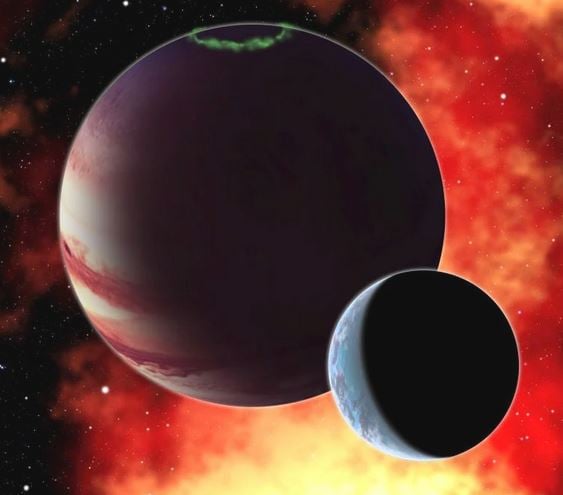
Among the most unusual are so-called rogue planets—worlds that have been ejected from their original systems and now drift freely through space. Long considered inhospitable, these planets are now being reconsidered. Research from the Ludwig Maximilian University of Munich and the Max Planck Institute for Extraterrestrial Physics suggests that their moons could tell a different story.
According to the study, if a moon orbiting a rogue planet possesses a dense, hydrogen-rich atmosphere and is subject to strong tidal forces, it could sustain subsurface oceans for billions of years.
The mechanism is striking: as these moons follow elongated orbits, gravitational interactions continuously deform their interiors. This generates heat through friction—enough to maintain liquid water even in the absence of starlight.
In such environments, the atmosphere becomes crucial. While carbon dioxide would freeze under these conditions, hydrogen can act as an effective insulator. Through a process known as collision-induced absorption, hydrogen molecules trap heat and help stabilize the environment.
The findings also draw parallels with early Earth, where high hydrogen levels—possibly from asteroid impacts—may have contributed to the emergence of life. Tidal processes could further create wet-dry cycles, considered essential for the formation of complex molecules.
The implications are profound. Potentially habitable environments may be far more widespread than previously thought. Given that rogue planets could be abundant, their moons might host stable conditions for billions of years.
This research significantly broadens the scope of astrobiology, suggesting that life could arise and persist even in the most isolated and lightless regions of the universe.