

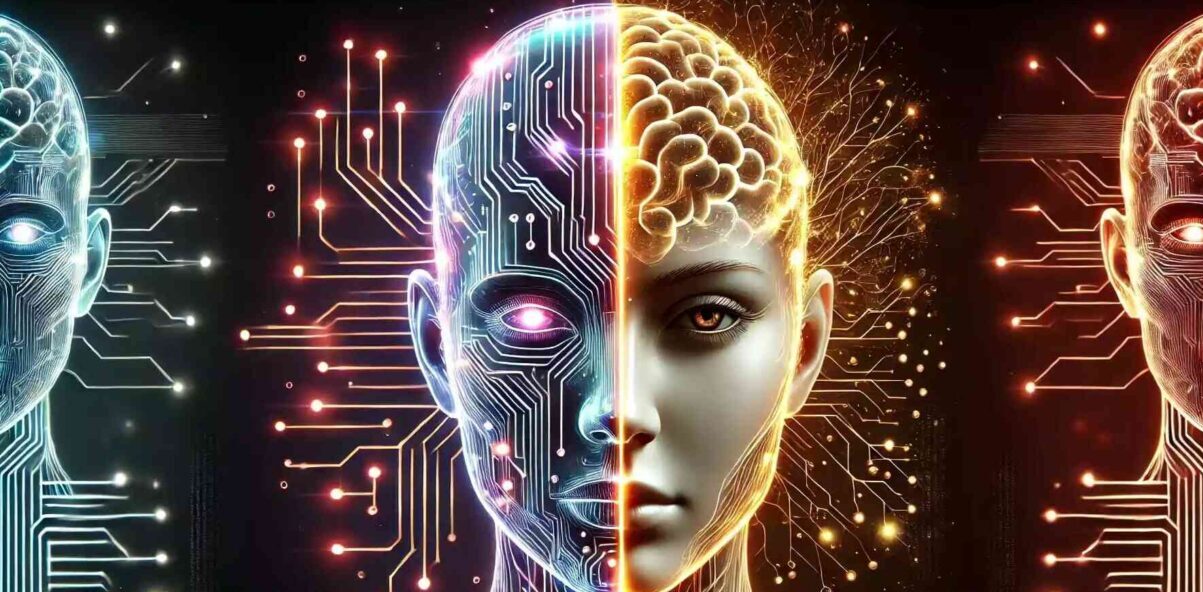
Throughout history, humans have sought role models to shape their thinking and behavior. From early childhood, imitation serves as a fundamental mechanism of learning and socialization, enabling the transmission of values, knowledge, and norms.
Role models are not always consciously chosen or inherently ideal. Often, individuals adopt selected traits that resonate with them. Crucially, imitation is never total; it is selective and creative, allowing individuals to adapt influences into their own identity.
This process, which evolves from unconscious absorption to conscious choice, lies at the core of human development. At its most mature stage, imitation becomes synthesis rather than replication.
In the modern era, however, the rise of artificial intelligence introduces a new dynamic. AI systems do not imitate humans through intention or understanding; instead, they identify and reproduce patterns from vast datasets. Their “human-like” responses are the result of statistical processing, not awareness.
Yet a paradox is emerging: while AI is built on human-generated patterns, humans are increasingly influenced by the way AI operates. Imitation appears to be reversing direction.
Shifts in everyday behavior
This shift is already visible. Communication is becoming more structured, neutral, and concise, often at the expense of spontaneity and emotional expression. Thinking is increasingly oriented toward finding the “correct” answer rather than exploring possibilities or questioning assumptions. Decision-making, meanwhile, shows growing reliance on systems that provide ready-made solutions, sometimes without scrutiny of how those answers are produced.
The risk of shifting authority
A central concern arises: could humans begin to imitate artificial intelligence? As AI outputs reflect patterns of human reasoning, there is a risk that individuals may adopt these patterns uncritically, limiting their own judgment and originality.
Convenience plays a key role. AI offers fast, coherent, and persuasive answers, reducing the need for personal effort. However, knowledge acquired without effort is often not deeply understood.
The deeper risk is not that humans will become machines, but that authority will gradually shift—from human judgment to algorithmic outputs. When answers are accepted without critical evaluation, AI ceases to be a tool and becomes a reference point.
This may lead to weakened critical thinking, diminished authentic expression, and increased dependence on external sources of knowledge. In such cases, imitation becomes passive rather than creative.
Toward a balanced relationship
Despite these risks, AI’s influence is not inherently negative. Its clarity, structure, and analytical rigor can enhance human thinking when used appropriately.
The key lies in conscious use: leveraging AI without allowing it to replace human cognition.
The relationship between humans and AI is reciprocal but not equal. Humans possess judgment, experience, values, and consciousness—qualities machines do not have. If these are relinquished, the issue is not AI rising to human level, but humans lowering their own.
In a world saturated with ready-made answers, the ability to ask questions, challenge assumptions, and think independently becomes more valuable than ever. Thinking is not merely about finding answers—it is a process of inquiry.
Ultimately, the question is not whether AI will influence us—it already does. The real challenge is whether we remain active creators of thought or become passive imitators of patterns.