
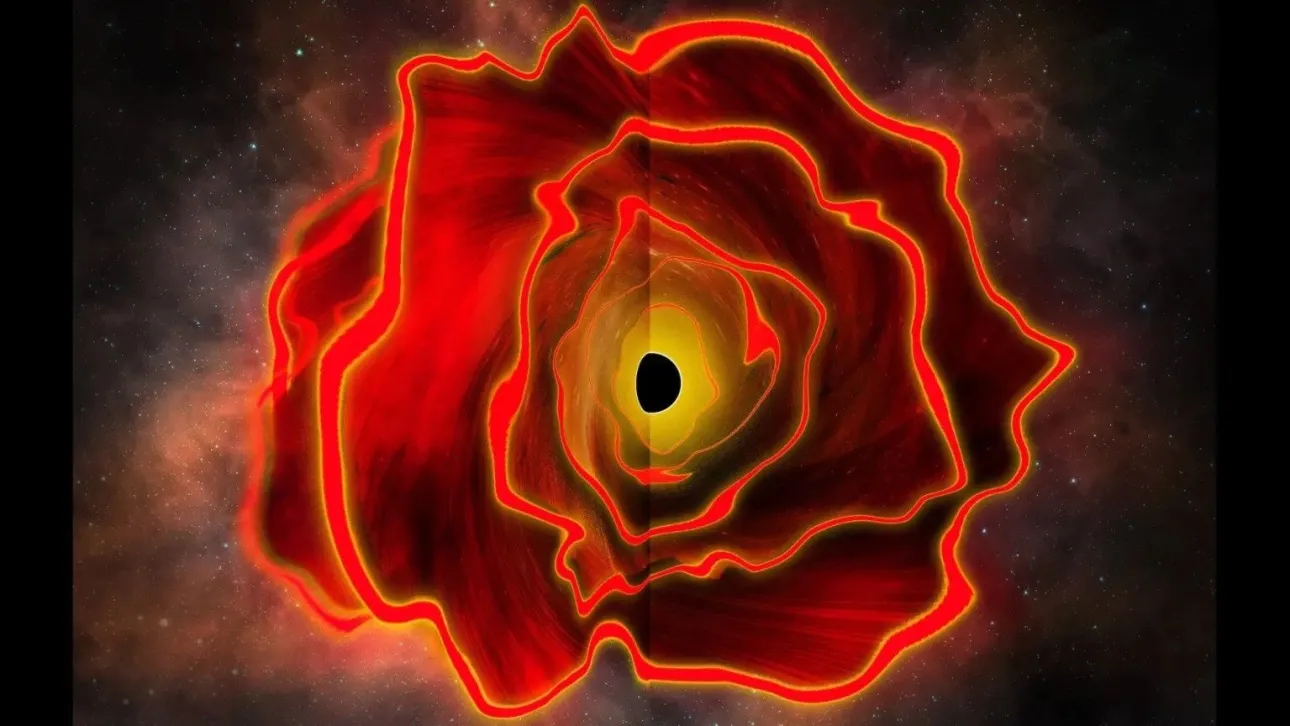
Astronomers may have identified a previously unknown class of extremely luminous cosmic objects hidden in observations of the early Universe made by the James Webb Space Telescope. The object, known as MoM-BH-1*, appears to combine a massive black hole with a dense envelope of gas, forming a structure roughly comparable in size to our Solar System.
The object is extraordinarily bright around 100 billion times brighter than an ordinary star and a new study published in Nature suggests that it could represent a new type of object that researchers describe as a “black hole star.”
If confirmed, the finding could help address two major mysteries highlighted by James Webb observations: the nature of the mysterious “little red dots” appearing throughout the early Universe and the question of how the first supermassive black holes grew so rapidly after the Big Bang.
A star powered by a black hole
At the heart of MoM-BH*-1, researchers estimate, lies a black hole with a mass roughly 100,000 times that of the Sun. Surrounding it is an enormous, extremely dense cloud of gas, creating a structure that from a distance could resemble a gigantic star.
But its energy source would be fundamentally different.
Ordinary stars shine because of nuclear fusion occurring in their interiors. In MoM-BH*-1, by contrast, the immense luminosity appears to come from matter being pulled toward the central black hole. As the material falls inward, it heats to extreme temperatures and releases enormous amounts of energy.
The object is so distant that the light reaching Earth today began its journey roughly 13 billion years ago, when the Universe was only about 660 million years old.
The mystery of the “little red dots”
Since the beginning of James Webb’s observations, astronomers have detected numerous small, extremely bright and reddish objects in very distant galaxies.
Known as “little red dots,” these objects have become one of the major puzzles emerging from the telescope’s observations of the early Universe. Their true nature remains uncertain.
The new study proposes that at least some of them could be black holes concealed within enormous quantities of dense gas.
If confirmed, the little red dots could represent an important stage in the evolution of the Universe’s earliest black holes.
How the object was discovered
MoM-BH*-1 was detected almost by chance by the team behind the “Mirage or Miracle” program, which was searching for extremely distant and ancient galaxies.
The researchers spotted an unusually bright red source. They initially considered whether its color might be caused by large amounts of cosmic dust. However, the characteristics of its light did not fully match that explanation.
The team then developed different theoretical models to explain the observed radiation. Models involving an extremely powerful energy source surrounded by hydrogen came closer to reproducing the observations.
When the researchers introduced a black hole at the center of the system, the resulting models showed an even closer match with the James Webb data.
A possible new stage in black-hole evolution
The researchers believe MoM-BH*-1 may not be an isolated phenomenon but the first identified member of an entire class of cosmic objects.
If a significant fraction of the little red dots turn out to be similar black hole stars, the discovery could reshape our understanding of how the Universe’s first supermassive black holes formed.
The central question is how some black holes managed to grow to billions of solar masses within only a few hundred million years after the Big Bang.
Black hole stars could represent an intermediate stage that allows an initial black hole to grow at an exceptionally rapid rate, potentially offering a solution to one of the most important cosmological puzzles raised by the James Webb Space Telescope.