

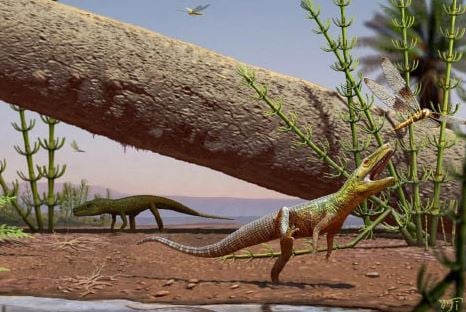
A previously unknown prehistoric reptile that lived around 240 million years ago is helping scientists fill a major gap in the evolutionary history of archosauromorphs—the ancient reptile group that eventually gave rise to dinosaurs, crocodiles and pterosaurs.
The newly identified species, Silescelida acristata, was discovered from fossils unearthed in southern Brazil and dates to the Middle Triassic, a period when life on Earth was recovering and diversifying after the catastrophic end-Permian mass extinction. During this time, archosauromorphs were beginning to dominate terrestrial ecosystems, setting the stage for the later rise of the dinosaurs.
Researchers believe the animal belonged to the enigmatic Euparkeriidae, a poorly understood family of early archosauromorph reptiles. Until now, the only undisputed member of this group had been Euparkeria capensis, first described from South Africa more than a century ago.
According to lead author Mauricio Garcia of the Federal University of Santa Maria, euparkeriids occupy a crucial position on the evolutionary tree, just outside the true Archosauria. As a result, they provide valuable clues about the ancestral body plan from which both crocodiles and dinosaurs ultimately evolved.
Fossils Reveal an Agile Predator
The new species was identified from three fossilized bones recovered in Brazil’s Rio Grande do Sul state: a shoulder blade, part of the pelvis and a femur measuring approximately 17.3 centimeters in length.
Based on the anatomy of these remains and comparisons with related species, researchers conclude that the reptile was a fast moving predator with long hind limbs, likely capable of walking primarily on two legs. It probably resembled a large lizard in appearance and occupied the role of an active terrestrial hunter within its ecosystem.
Expanding the Evolutionary Picture
The discovery significantly extends the known geographic range of the Euparkeriidae and strengthens the hypothesis that South America played a key role in the earliest stages of archosauromorph evolution.
The research team says Silescelida acristata not only provides new evidence about the distribution and diversity of this elusive reptile lineage but also represents the first record of this evolutionary grade of archosauromorphs from Brazil’s Triassic deposits. More broadly, the discovery highlights the importance of South America’s Triassic fossil record for reconstructing the evolutionary origins of the reptiles that would eventually give rise to crocodiles and dinosaurs.