

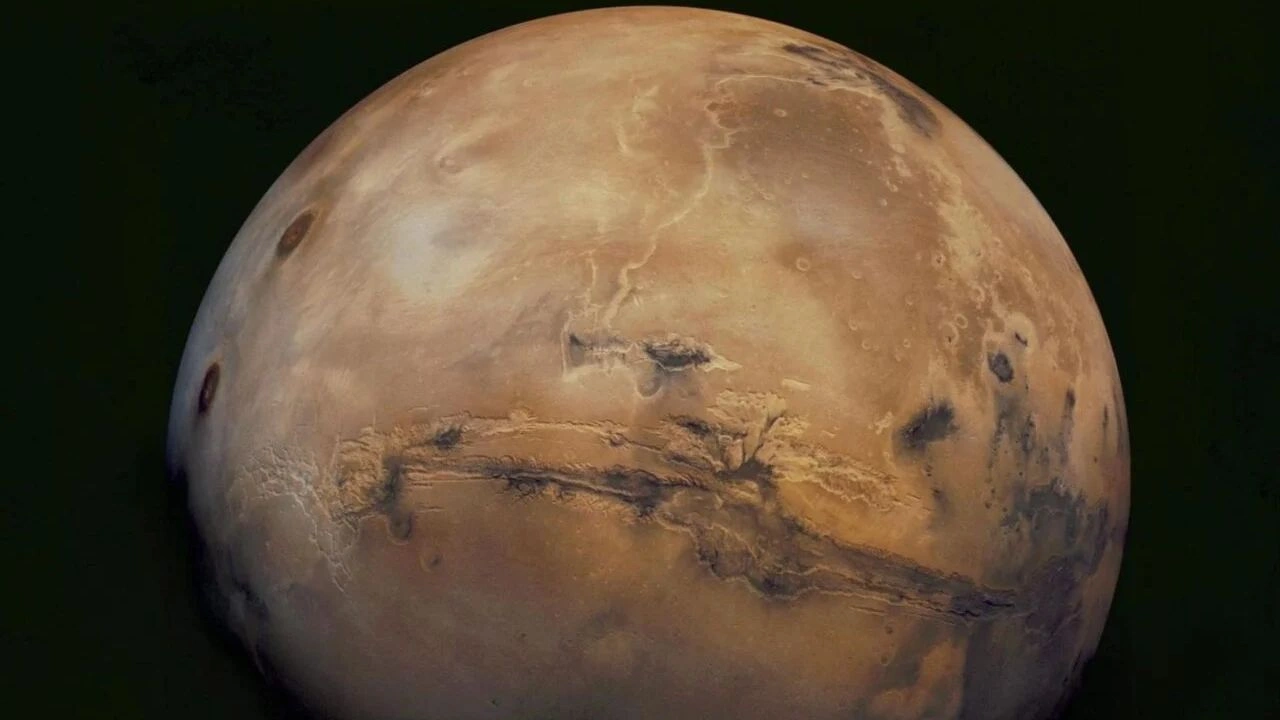
A one-way journey to Mars currently takes between seven and ten months, depending on Earth’s position relative to the Red Planet. However, a new scientific study suggests that this time could be dramatically reduced, with a round-trip mission potentially lasting as little as 153 days.
According to research published in the journal Acta Astronautica, astronomer Marcelo de Oliveira Souza of the State University of Northern Rio de Janeiro analyzed the trajectory of the asteroid 2001 CA21 in search of alternative routes for missions to Mars.
The planning of interplanetary missions relies heavily on orbital dynamics, as the distance between Earth and Mars constantly changes due to their motion around the Sun. The most favorable conditions occur roughly every 26 months, during what is known as the opposition of Mars, when suitable launch windows typically open.
The researcher set out to determine whether less obvious but more efficient routes might exist within these time windows. Rather than relying solely on traditional models, he used the predicted trajectory of a near-Earth asteroid that intersects the orbits of both Earth and Mars.
The analysis focused on three future launch windows – 2027, 2029, and 2031. Of these, only the 2031 window showed a favorable alignment between the two planets and the asteroid’s orbital plane.
The findings outline two possible round-trip mission scenarios for 2031: one lasting approximately 153 days and another about 226 days. Although these are theoretical trajectories rather than immediately actionable mission plans, the study points to a new way of thinking about interplanetary travel.
Until now, asteroids have primarily been monitored as potential threats to Earth. However, this new approach highlights a different role for them – as potential “navigation guides” that could help scientists identify faster routes through our solar system.