

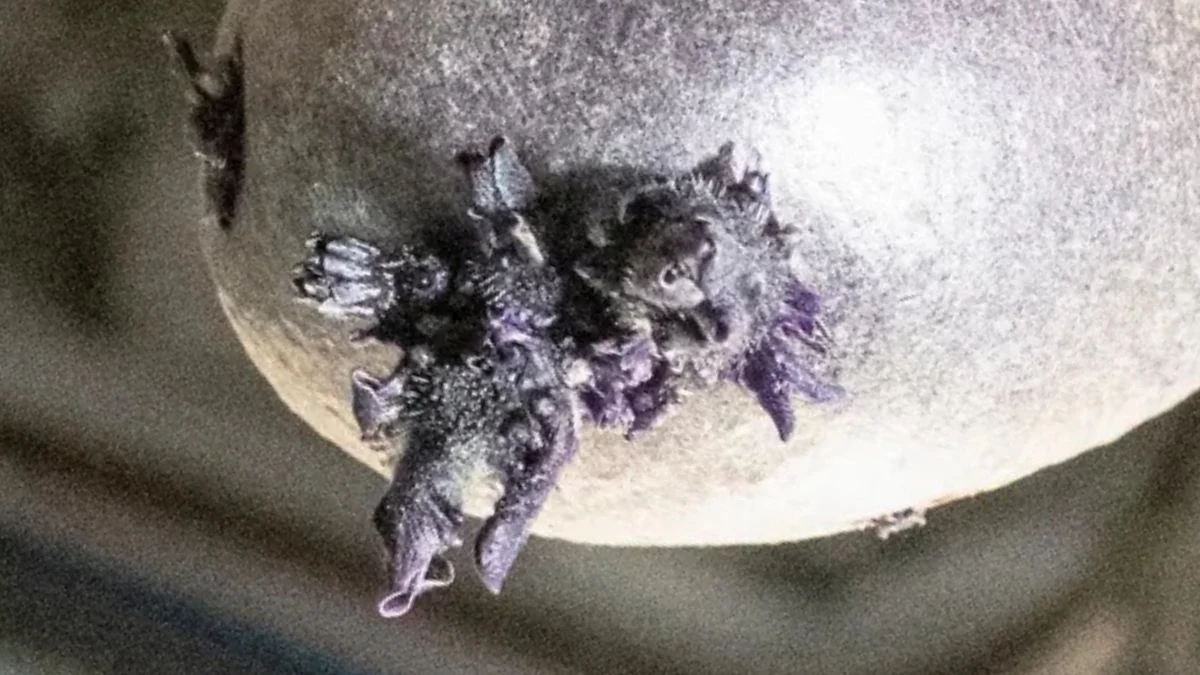
A photo recently shared by NASA astronaut Don Pettit sparked a wave of reactions on social media. The object in the image—a purple “egg” sprouting strange tentacle-like shapes—looked to many like something straight out of science fiction.
Comments quickly followed: “It looks like an alien egg” and “burn it with fire” were among the most popular reactions. But the truth turned out to be far less extraterrestrial.
The mysterious object was simply a sprouting potato grown aboard the International Space Station. The “tentacles” were shoots, while a small piece of Velcro held the potato in place in microgravity.
Pettit jokingly named it “Spudnik-1,” adding it to his personal “space garden”—a hobby he pursues during downtime on the station.
The potatoes are grown using hydroponics, meaning they develop without soil in nutrient-rich water. Pettit has experimented with space gardening before, cultivating a range of plants from zucchini and broccoli to basil and tomatoes.
This work is more than a pastime. Growing food in space is a key area of research for future missions. Potatoes, in particular, are considered ideal due to their high nutritional value relative to their mass.
Their importance has even been popularized in the film The Martian, where the character played by Matt Damon survives on Mars by growing potatoes.
Although the first successful potato cultivation experiments in space date back to the 1990s, scientists are still studying how microgravity affects plant growth. According to Pettit, growth appears slower, possibly due to environmental stress or the unique conditions aboard the station.
Encouragingly, however, no harmful effects from space radiation have been observed so far.
From a viral “alien” photo to a meaningful scientific experiment, the story of “Spudnik-1” shows how even a simple potato can play a role in shaping the future of space exploration.