

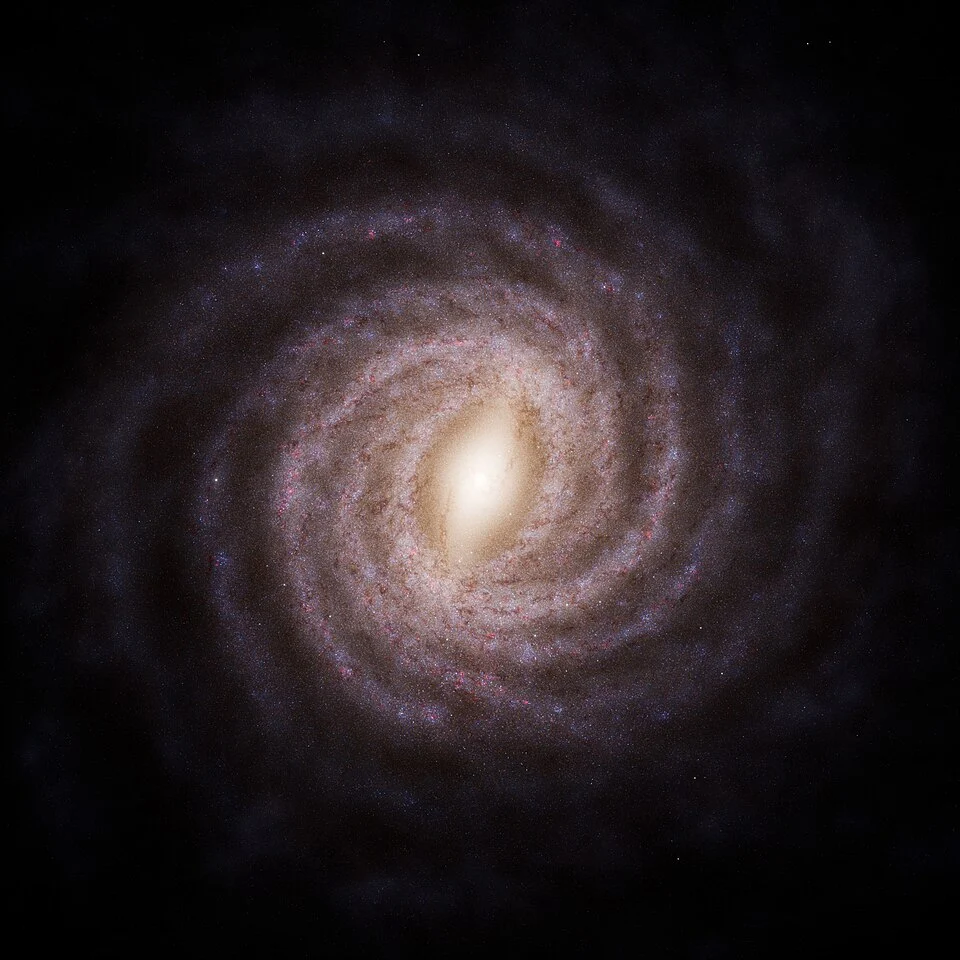
The Milky Way may be larger than astronomers have long believed. A new study suggests that the galaxy’s spiral arms extend farther into space than previous measurements indicated, potentially reshaping scientists’ understanding of the structure and mass of our cosmic home.
Although the Milky Way’s spiral nature was first recognized in the 19th century, astronomers continue to refine its map. In the latest research, scientists analyzed observations from NASA’s Chandra X-ray Observatory and the European Space Agency’s XMM-Newton telescope to obtain highly precise measurements of the galaxy’s spiral arms.
The results indicate that the outer spiral arms lie farther away than previously estimated. While the differences are relatively modest, researchers say they could have important implications for calculating the Milky Way’s total mass and understanding how matter is distributed throughout the galactic disk.
“Even small revisions to the distances of the spiral arms are significant because they underpin our understanding of the Milky Way’s structure,” said study co-author Ilaria Fornasiero.
Using the Universe’s Most Powerful Explosions as Measuring Tools
To determine these distances, the researchers employed an innovative geometric technique based on gamma ray bursts the most energetic explosions known in the Universe.
Although these explosions occur in galaxies far beyond the Milky Way, the X-rays they emit travel across space and scatter off clouds of interstellar dust within our galaxy. This scattering produces expanding rings of X-ray light whose size and evolution allow astronomers to calculate the distance to the dust clouds and therefore to the spiral arms with remarkable precision.
Lead author Beatrice Vaia explained that the method relies purely on geometry rather than assumptions about the Milky Way’s rotation, which become increasingly uncertain in the galaxy’s outer regions.
A New Map of the Milky Way
The team analyzed X-ray data from three gamma ray bursts to study three of the Milky Way’s spiral arms: the Perseus Arm, the Outer Arm and the Outer Scutum Centaurus Arm.
Their measurements suggest that both the Outer Arm and the Outer Scutum Centaurus Arm are located roughly 10% farther away than previous estimates indicated.
Researchers also measured the thickness of the galaxy’s outermost spiral arm, estimating it to be approximately 3,500 light years across. This achievement provides a more complete picture of the arm’s true structure rather than the position of a single dust cloud.
Why the Discovery Matters
Although the revised distances represent only modest changes, they could have far-reaching consequences. The findings may prompt astronomers to revisit models describing the Milky Way’s mass, rotation and overall architecture, while also improving our understanding of how spiral galaxies evolve throughout the Universe.
The researchers note, however, that the technique cannot be used routinely because suitable gamma ray bursts are exceptionally rare.
“We rely on the Universe itself to provide these extraordinary events,” said study co-author Andrea Tiengo. “In 25 years of observations, we have found only a handful of cases suitable for this kind of measurement.” Even so, astronomers plan to continue searching for future gamma ray bursts that may reveal even more about the true dimensions of our galaxy.