

Scientists have identified a new active tectonic rift beneath Zambia that may represent an early stage of a geological process capable of eventually splitting the African continent in two over millions of years.
The newly studied structure, known as the Kafue Rift, forms part of the Southwest African Rift System, a vast fracture zone stretching roughly 2,500 kilometers from Tanzania to Namibia. According to a recent scientific study, the rift appears to have penetrated the Earth’s crust completely, allowing fluids from the planet’s mantle to rise toward the surface.
Researchers reached this conclusion after analyzing gases released from hot springs in Zambia. The samples contained unusually high concentrations of helium and carbon isotopes typically associated with Earth’s mantle rather than the atmosphere or surrounding rocks.
Professor Mike Daly of the University of Oxford, one of the study’s authors, said the findings provide strong evidence that the rift system is geologically active. The upward movement of mantle-derived fluids suggests that tectonic processes are currently reshaping the region beneath southern Africa.
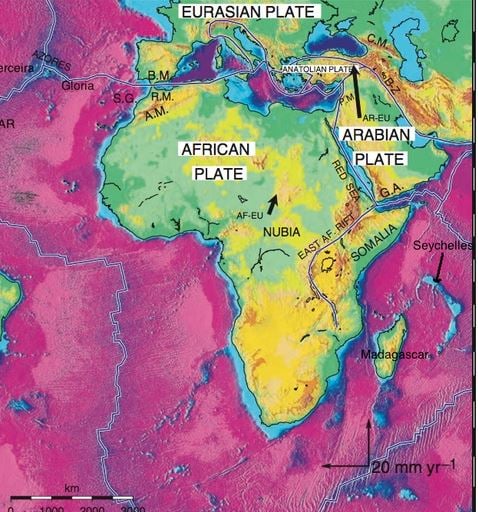
Scientists note that Africa is already slowly breaking apart along the East African Rift System, where the African tectonic plate is gradually separating into the Somali and Nubian plates. However, the movement is extremely slow, progressing at only a few millimeters per year.
Although researchers stress there is no immediate danger to nearby populations, the Kafue Rift could eventually evolve into a full tectonic plate boundary. For that to happen, the fracture would need to extend deeper into the mantle, triggering partial melting and volcanic basalt formation.
Geologists emphasize that these processes unfold over immense geological timescales. Even so, the discovery is considered highly significant because it offers new insight into how tectonic boundaries develop and how the African continent could continue to change shape in the distant future.