
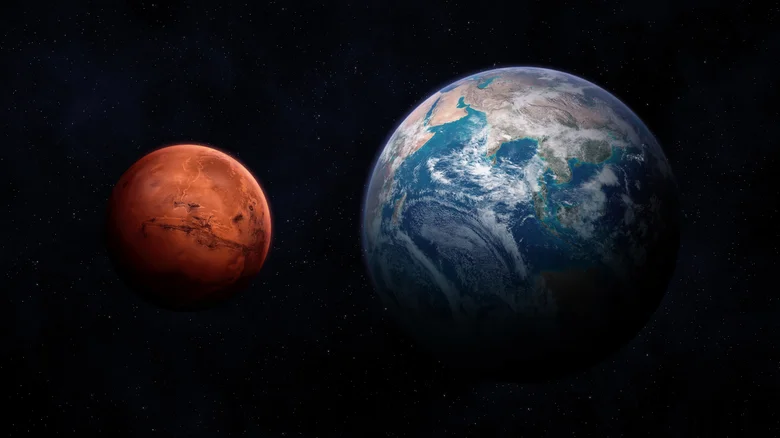
Time flows differently on the planet Mars—not metaphorically, but in a measurable way that can jeopardize a mission and give NASA engineers a serious headache.
A clock on Mars “runs” 477 microseconds faster per day than a clock on Earth, according to a study by researchers Neil Ashby and Bijunath R. Patla published on the arXiv repository. This difference varies by an additional 226 microseconds per day, depending on the planet’s position in its orbit around the Sun.
Microseconds may sound insignificant to us, but they are critical when attempting to land a billion-dollar spacecraft or synchronize with robots already operating on Mars. At the speed of light, a delay of just 56 microseconds corresponds to a distance of roughly 184 football fields—miss that window and you miss the landing zone entirely, as BGR.com notes.
The issue is not limited to Mars. NASA’s Artemis program plans to link infrastructure on Earth, the Moon, and Mars. The new study shows that clocks on Mars run 421.5 microseconds faster per day than clocks on the Moon. As a result, three worlds with three different time rates will need to remain perfectly synchronized.
Solar tides are to blame
The cause of the problem is not a lack of understanding of relativity. On the contrary, Einstein’s theory is well established: gravity and motion distort spacetime, causing clocks to tick at different rates. The issue is that our models for calculating these effects have been overly simplified.
For decades, models treated planetary systems as two-body problems: Earth–Moon or Earth–Mars. But the Sun does not remain a passive background presence. Its strong gravity causes what physicists call solar tides—small but critical perturbations in the orbits of planets and moons that affect the precise flow of time.
When Ashby and Patla incorporated these solar effects into their calculations for the Earth–Moon system, they achieved accuracy 100 times greater than previous models. However, significant gaps remain for the Earth–Mars system, as the effects of solar tides on Earth’s orbit have not yet been fully integrated into the data.
The GPS problem on an interplanetary scale
Every GPS satellite orbiting Earth already faces this issue. Their clocks run faster than those in smartphones because they are farther from Earth’s gravity. If this difference were not corrected, GPS positioning would drift by several kilometers after just a few hours. On an interplanetary scale, involving three celestial bodies and solar perturbations, the problem multiplies.
NASA must manage this complexity for missions such as Mars Sample Return, which aims to bring samples of Martian soil back to Earth, as well as for the long-term planning of permanent bases and human presence on Mars. The White House has already asked NASA to establish a Coordinated Lunar Time, analogous to Coordinated Universal Time (UTC) on Earth, and the new study provides the foundation for creating a similar system for Mars.
In the next era of space exploration—where every microsecond can determine the survival of a mission—understanding how time flows differently on each celestial body shifts from a theoretical pursuit to a technical necessity.