
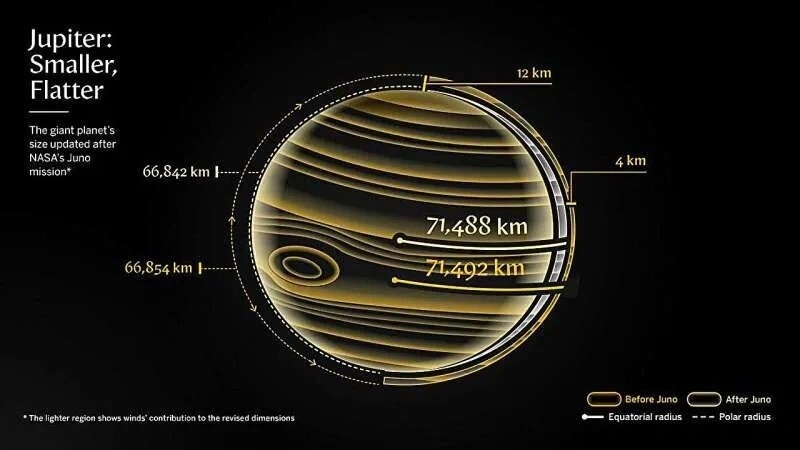
The planet Jupiter turns out to be slightly smaller and flatter than scientists believed for decades, according to a new study based on radio data from NASA’s Juno spacecraft.
Although the differences in the measurements are small, they are considered scientifically significant, as they improve models of the internal structure of the largest planet in the Solar System and of similar gas giants beyond it. The findings were published in the journal Nature Astronomy.
“Textbooks will need to be updated,” said study co-author Yohai Kaspi, a planetary scientist at the Weizmann Institute of Science in Israel. “Jupiter hasn’t changed, of course — but the way we measure it has.”
From Voyager to Juno
Until now, scientists’ understanding of Jupiter’s size and shape was based on just six measurements taken about 50 years ago by the Voyager 1 and 2 missions and the Pioneer 10 and 11 spacecraft. These measurements have long served as the standard reference.
NASA’s Juno mission, which has been orbiting Jupiter since 2016, has provided a far larger and more precise set of radio data. According to LiveScience, the new measurements achieve an accuracy of about 400 meters in every direction.
Researchers tracked radio signals sent from Juno to Earth, which bent as they passed through Jupiter’s atmosphere and ultimately disappeared when the planet fully blocked the signal. This approach allowed scientists to account for the planet’s powerful winds, which subtly affect its shape, leading to more accurate calculations of Jupiter’s dimensions and internal structure.
What the new measurements show
Based on the updated data, Jupiter’s polar radius — from the center to the pole — is now estimated at about 66,842 kilometers, roughly 12 kilometers smaller than previous estimates. The equatorial radius is estimated at approximately 71,488 kilometers, about 4 kilometers smaller than previously thought.
While these differences may seem minor, scientists emphasize that they are important. The refined measurements allow interior models of the planet to better match gravity data and atmospheric observations.
Why it matters
A more accurate picture of Jupiter extends beyond the planet itself. The updated measurements are expected to help researchers better interpret data from gas giant exoplanets as well.
“Jupiter was likely the first planet to form in the Solar System,” Kaspi said. “By studying what is happening inside it, we move closer to understanding how the Solar System formed — and, ultimately, how planets like Earth came to be.”