
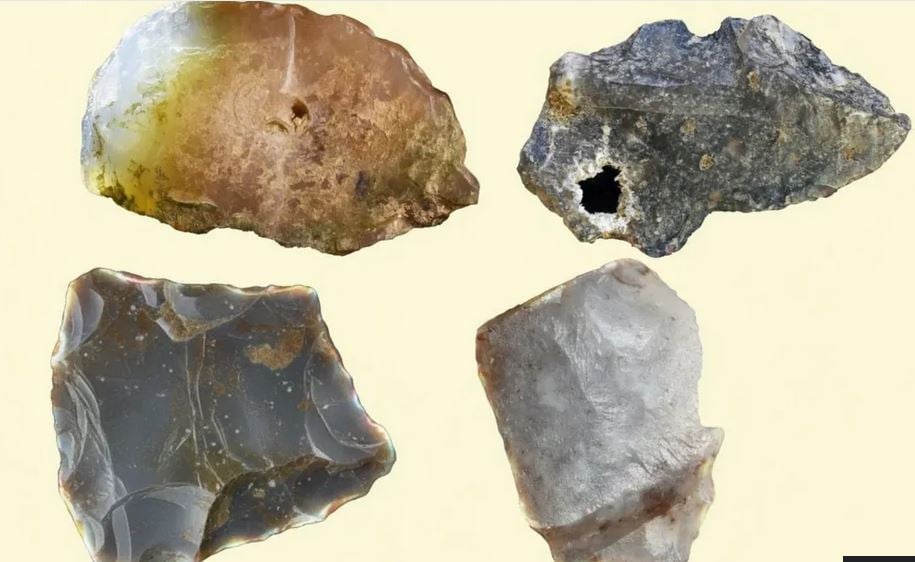
Early human species millions of years ago did not have limited intelligence, as one might assume, but instead developed significant abilities, including toolmaking, and even passed this knowledge on to subsequent generations, according to new findings in northwestern Kenya.
Researchers found that humans living around 2.75 million years ago at an archaeological site called Namorotukunan used stone tools continuously for 300,000 years. Until recently, evidence suggested that tool use by early humans was sporadic—appearing randomly and then quickly disappearing.
The discovery at Namorotukunan is the first to show that this technology was transmitted from generation to generation over thousands of years.
According to Professor David Braun of George Washington University in Washington, who led the research published in Nature Communications, this finding is strong evidence that our understanding of human evolution needs a radical reassessment.
“We thought that tool use might have been something fleeting that disappeared quickly. But when we see 300,000 years of continuous activity, that simply cannot be the case. This points to a long-term continuity of behavior. Tool use in humans and their ancestors likely began much earlier and was far more continuous than we previously believed,” Braun said.
The findings
The stone tools were so sharp that researchers could cut their fingers on some of them. Archaeologists worked at Namorotukunan for ten years and uncovered around 1,300 sharp flakes, stone hammers, and stone cores, all made through careful knapping of rocks collected from riverbeds.
These tools represent Oldowan technology, the first widely distributed stone toolmaking tradition.
The same types of tools were found in three different geological layers corresponding to different time periods.
Many of the stones had been carefully selected for their quality, indicating that their makers were skilled and knew exactly what they were looking for, according to geoscientist Dr. Danilo Rolim of the University of São Paulo in Brazil.
“What we see here is an incredible level of complexity. These people were remarkably perceptive geologists. They knew how to find the best materials, and their tools are truly exceptional. We can cut our fingers on some of them,” Rolim told the BBC.
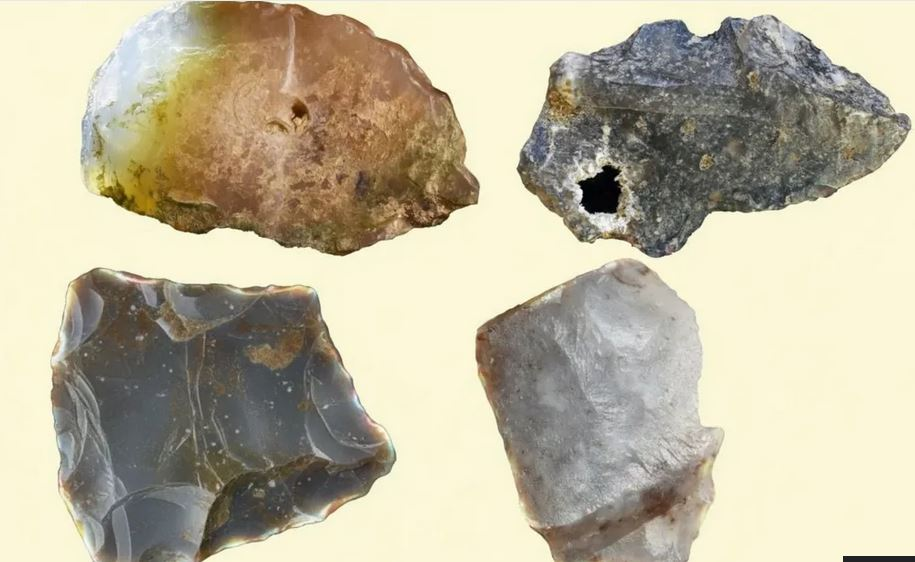
They may look like simple stones, but they are in fact highly precise tools designed exactly for the purposes intended by their makers. (Photo source: David Braun)
Their use
Geological evidence shows that the use of tools likely helped these early humans survive dramatic climate changes. “The landscape transformed from rich wetlands into dry, scorched savannas and semi-deserts,” said Rahab Kinyanjui, senior scientist at the National Museums of Kenya.
Such rapid environmental changes would have forced most animals either to adapt evolutionarily or to migrate. However, the toolmakers in the region thrived thanks to technology, as Rolim explained. “Technology allowed the early inhabitants of East Turkana to survive in a rapidly changing environment not by adapting their bodies, but by adapting the way they obtained food.”
The presence of tools in different geological layers indicates that, for a long and uninterrupted period, these early humans resisted natural evolutionary pressures by controlling their environment rather than allowing the environment to control them.
“Tool use meant they did not need to evolve biologically to adapt to the changes. Instead, they developed the technology they needed to obtain food—tools to slice animal carcasses and to dig up plants,” Rolim said.
The Namorotukunan site, located in the Turkana Basin in Kenya, lies near the ancient bed of a river that has since dried up and once attracted settlements of early humans and their ancestors. Evidence there shows that these tools were used to butcher animal bones—proof that these people relied on meat as a stable food source.
“Technology gave these early inhabitants an advantage. They were able to access different types of food as the environment changed. Food sources shifted, but thanks to their tools they could overcome these obstacles,” according to Rolim.
The inventors
Around 2.75 million years ago, the area was inhabited by some of the earliest humans, who had relatively small brains. These early humans appear to have coexisted with pre-human groups, the australopithecines, who had larger teeth and features intermediate between chimpanzees and humans.
The creators of the tools at Namorotukunan likely belonged to one or both of these groups. The discovery overturns the established view that continuous tool use emerged much later, between 2.4 and 2.2 million years ago, when the human brain had already increased significantly in size.
“Until now, the argument was that tool use was linked to an increase in brain size, because these tools helped support nutrition. But what we see at Namorotukunan is that these early tools were used long before brain size increased. We may have dramatically underestimated these early humans and our ancestors. We can now trace the roots of the human ability to adapt through technology much further back in time—up to 2.75 million years ago, and perhaps even earlier,” Braun said.