
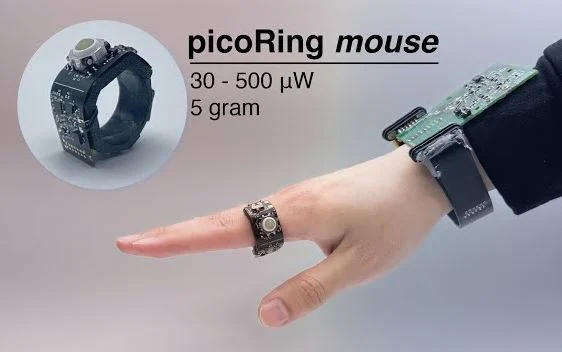
Researchers have developed a lightweight computer mouse worn like a ring that can operate for more than a month on a single charge. The device, called picoRing, weighs just 5 grams and is designed as a discreet, low-power alternative to traditional computer mice.
Its creators initially envision it as a potential controller for augmented reality (AR) and virtual reality (VR) systems, where compact, hands-free operation offers an advantage over conventional input devices. Users can scroll and interact with virtual environments through small hand movements, making picoRing ideal for settings with limited workspace.
Because the ring is in direct contact with the skin, future versions could monitor heart rate, stress levels, and other biological indicators, the researchers said. Combining these functions with interaction control could pave the way for “multifunctional wearable devices.”
“Although it is still a prototype, picoRing could meaningfully influence how people interact with technology. This could mean that long-lasting wearable technology becomes more common, while also offering a new, intuitive way to interact with augmented reality. It is more discreet, better suited for public spaces, more practical due to its small size, and could evolve into a platform for health sensors or other innovations,” said Ryo Takahashi, assistant professor in the Department of Electrical Engineering and Information Systems at the University of Tokyo.
The evolution
The humble computer mouse has existed for nearly 60 years, and although its design has evolved, attempts at radical reinvention have largely failed. Researchers hope that picoRing’s convenient form factor and long battery life will help it stand out, especially as “smart rings” are beginning to gain popularity.
“So-called smart rings suffer from short battery life because their small batteries (50–60 mWh) struggle to power the necessary communication components. To solve this problem, picoRing had to use hundreds of times less energy—around 30–500 microwatts,” Takahashi explains.
The long battery life is made possible by a unique energy system called semi-passive inductive telemetry (semi-PIT), which connects the ring to a bracelet that acts as an intermediary transmitter between the ring and the controlled device.
The system is based on a wire coil similar to those used in wireless chargers, but with small capacitors distributed along its length. This combination amplifies the magnetic fields that carry signals between the ring and the bracelet, extending the range without an external amplifier.
As a result, picoRing uses much weaker and more energy-efficient components than other wireless devices. The researchers ruled out technologies such as Bluetooth and NFC, since the former consumes too much power for such a small device, while the latter works only over very short distances.
As with many prototypes, picoRing has practical limitations: it is somewhat bulky, susceptible to interference, and currently supports only basic functions such as scrolling and clicking. The researchers argue that future improvements could make it smaller, more sensitive, and easier to use in everyday life. However, it is unlikely to replace conventional mice for intensive office work.
“For typical office tasks such as spreadsheets or extended editing, a standard mouse remains more comfortable. But as the technology evolves, picoRing could become a lightweight alternative for mobile or occasional use,” Takahashi concludes.