
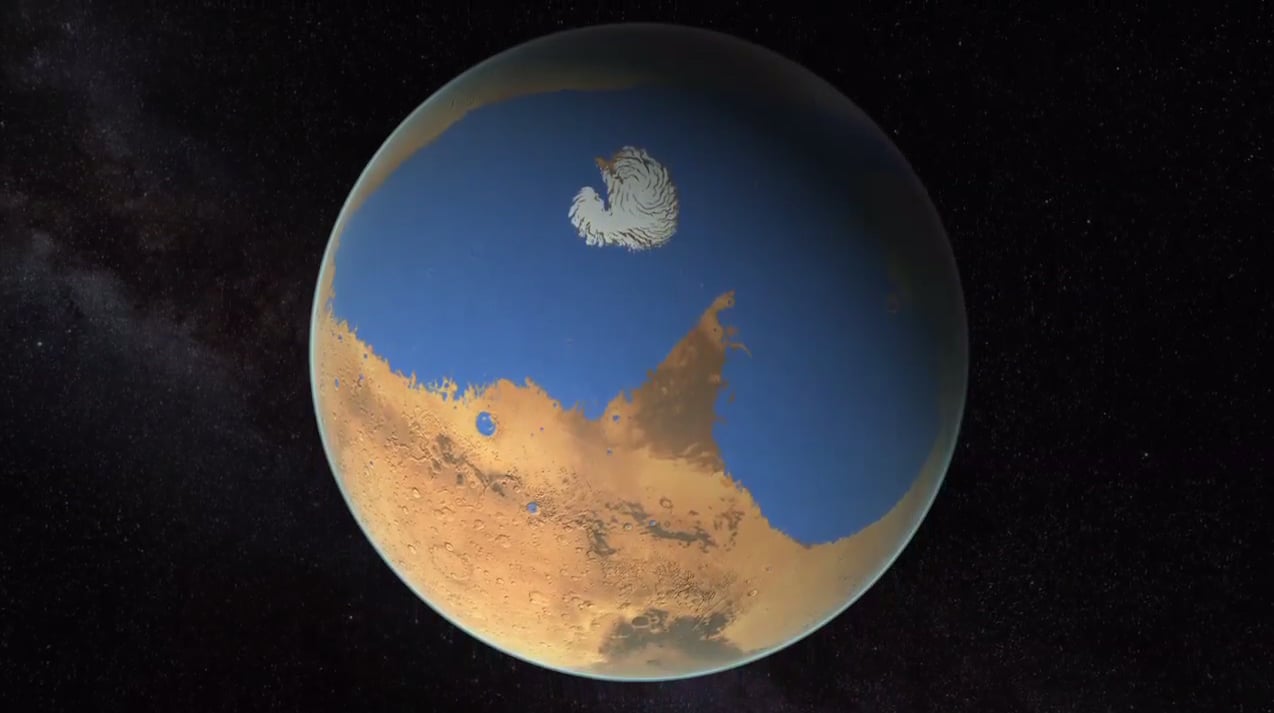
A large number of studies have indicated that Mars once had conditions similar to those on Earth and that, at some point, an ocean existed on the planet. A new study reports that this ocean was as large as the Arctic Ocean.
The scientific community has concluded that lakes and rivers once existed on Mars, raising the question of whether the planet may once have had conditions capable of supporting life. However, much remains uncertain about just how “blue” the Red Planet once was.
In the new study, scientists analyzed high-resolution images from various cameras aboard satellites and spacecraft studying Mars, including ESA’s ExoMars Trace Gas Orbiter, ESA’s Mars Express, and NASA’s Mars Reconnaissance Orbiter.
“Together, these instruments act like a geological time machine, helping us reconstruct the planet’s ancient conditions,” said Ignatius Argandestria, a planetary geologist at the University of Bern in Switzerland and lead author of the study. The scientists focused on the southeastern part of a 1,000-kilometer-long canyon called Coprates Chasma, part of Valles Marineris, the largest canyon system on Mars, which stretches more than 4,000 kilometers along the planet’s equator.
Martian deltas
Specifically, they studied geological structures known as scarp-faced deposits in the lower portion of Coprates Chasma. These are cone-shaped formations of sand and sediment that form where rivers flow into oceans. Although today these ancient river deltas are covered by wind-shaped sand dunes, their original form remains recognizable.
All the scarp-faced deposits identified by the scientists were found within the same elevation range, at depths of 3,650 to 3,750 meters in Valles Marineris and the northern lowlands. They are estimated to have formed about 3.37 billion years ago. The researchers suggested that these structures constitute evidence of an ancient shoreline. Overall, they estimated that Mars once had an ocean in its northern hemisphere at least as large as the Arctic Ocean on Earth.
“The most important conclusion is that Mars may have maintained stable surface water on a planetary scale for longer periods than we previously thought. Water on Mars may have formed connected systems over vast distances, rather than existing only in isolated lakes. The contribution of our study is that it provides a new geological line of evidence that helps determine where the shoreline may have been and how high the water level reached,” Argandestria says.
In the future, the researchers plan to examine the composition of ancient Martian soils, which could shed light on how erosion by water occurred.