
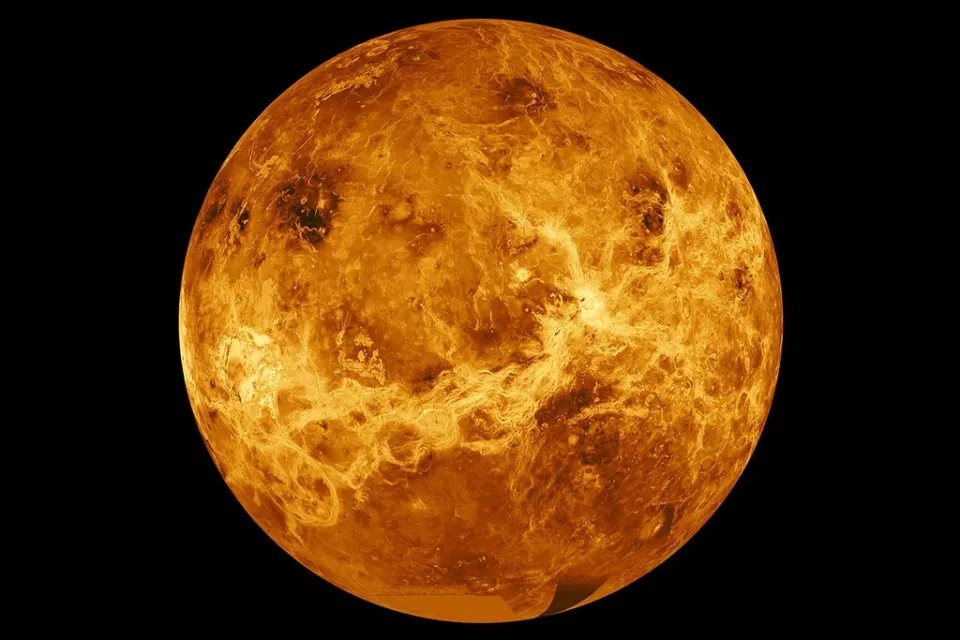
Volcanic activity is not an exclusive characteristic of Earth. Morphological features such as lava flows and subsurface tunnels have been documented on both Mars and the Moon. A recent study conducted by a research team from the University of Trento provides strong evidence for the existence of an extensive volcanic cavity beneath the surface of Venus, which may rank among the largest in the Solar System.
The research, supported by the Italian Space Agency and published in Nature Communications, was based on the analysis of synthetic aperture radar data. According to Lorenzo Bruzzone, lead author of the study and Director of the Remote Sensing Laboratory at the University of Trento, the identification of a volcanic cavity provides critical empirical validation for theoretical models that, until now, had not been observationally confirmed.
Methodology and Geomorphological Characteristics
The analysis relied on archival data from the Magellan spacecraft of NASA, which mapped the surface of Venus between 1990 and 1992. The researchers focused on morphological anomalies indicative of localized ground collapses and applied advanced signal-processing techniques to detect subsurface structures.
The results revealed a large cavity in the Nyx Mons region, with an estimated diameter of approximately one kilometer, a roof thickness of at least 150 meters, and a depth exceeding 375 meters. These geometric characteristics suggest a structure significantly larger than most known lava tubes on Earth and Mars, and comparable to the largest proposed or observed on the Moon.
Geophysical Factors and Formation Mechanisms
Lava tubes form when fluid lava flows beneath a surface crust that has already cooled and solidified, creating a thermally insulated conduit. Once the flow ceases, the emptied channel may persist as an भूमeteranean cavity. In the case of Venus, its relatively lower surface gravity compared to Earth, combined with its extremely dense atmosphere, may favor the preservation of extensive subsurface conduits, enabling the formation of large and structurally stable lava caves.
Researchers estimate that the underground conduit system may extend for at least 45 kilometers, although its full geometry and spatial extent remain to be confirmed.
Prospects for Future Investigation
The discovery gains additional significance in light of upcoming missions such as Europe’s Envision and NASA’s VERITAS, both of which will carry advanced radar instruments capable of higher-resolution mapping of Venus’s surface and subsurface.
Confirmation and detailed imaging of this structure could provide essential data for understanding Venus’s volcanic history, thermal evolution, and internal dynamics. As the researchers emphasize, this detection represents a preliminary yet crucial step in a broader scientific effort to clarify the geological evolution of the planet.