
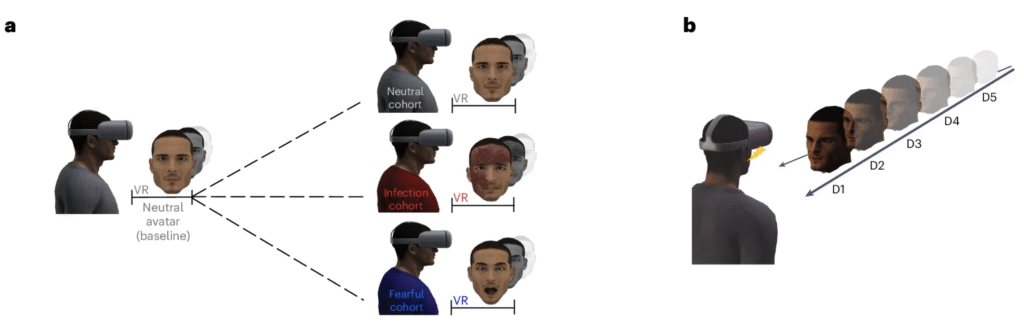
Visual contact with a person with visible symptoms of illness can activate an internal “alarm” in our brain and body, even if that person is too far away to actually infect us, researchers have found.
A series of experiments using virtual reality (VR) devices shows how “extremely sensitive” the human brain is to visual signs of sickness, according to Science Alert.
Participants in these experiments viewed virtual avatars at different distances. When they saw an avatar with clear signs of illness, their brains were immediately activated, and their immune system entered a heightened state of readiness. In contrast, when facing a neutral, healthy avatar, the brain did not show similar activation patterns, and blood tests showed no immediate increase in immune markers.
Increase in immune markers
Some of these markers are known as innate lymphoid cells (ILCs). ILCs can increase in the blood when the body is directly exposed to a pathogen, but in this case, simply seeing a virtual infection and the prospect of exposure was enough to cause their levels to spike.
“The data suggest that ILCs respond to infections not only when they are detected within the body, but also when the brain processes the possibility of an approaching threat,” the researchers note.
A statistical analysis of the results using machine-learning techniques showed that brain activity involved in threat detection could largely explain the immune response.
After viewing a sick avatar from a distance, the participants’ brains displayed a distinct activation pattern that was not observed when the avatar had a frightened or neutral expression.
Interestingly, the sick avatars that were farther away triggered the strongest reaction from the brain’s network. Some of the activated regions are the same as those that can be stimulated after receiving a flu vaccine.
In a state of readiness
The findings of the study, published in Nature Neuroscience, indicate that the brain mobilizes quickly when it perceives a potential threat, activating regions such as the hypothalamus, which then communicates with the immune system, giving the body time to prepare its defenses.
The experiments were conducted on a total of 248 healthy adults. In one of them, participants had to press a button as soon as they felt a touch on their face. When their devices showed a sick avatar, they pressed the button faster compared with when they saw a neutral or frightened avatar—an indication that the brain was already in a state of readiness.
The researchers note that further study is needed to understand how perceived infectivity or feelings of disgust influence this response. “The findings point to an integrated neuro–immune response to infection threats, not only when there is physical contact,” they conclude.
Leave a Reply