
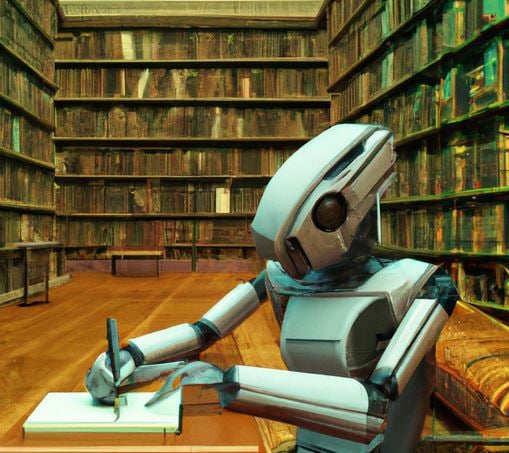
British writers are considered among the best in the world, but half of them believe it is very likely that they will soon be replaced by artificial intelligence. This is the conclusion of a study conducted by researchers at the University of Cambridge, based on responses from 258 novelists and 74 publishing professionals regarding how they view and use Artificial intelligence in the world of literature.
Over the coming decades, AI may be able to mass-produce novels, while human writers will struggle to compete, experts fear. This means that the next Charles Dickens, Agatha Christie, or J.R.R. Tolkien may never be discovered, while AI will create books by “mining” material from the work of previous authors.
And the news is particularly troubling for lovers of romance, crime, or thriller novels, as these genres are the most at risk. More than half (51%) believe that AI will eventually fully replace their jobs, while over a third say their income has already been affected by the technology.
At the same time, some creators imagine a dystopian, two-tier market in which the human-written novel becomes a “luxury good,” while AI-generated mass-production books will be cheap or free. “There is widespread concern among novelists that language models trained on vast amounts of literature will undermine the value of writing and compete with human authors,” said the study’s lead researcher, Dr. Clémentine Collett of the University of Cambridge.
Experimental writing
The study also revealed that 59 percent of writers are aware that their work has been used to train language models such as ChatGPT without permission or compensation. “Many authors doubt whether there will be future demand for complex, long-form writing. The novel is a precious and vital form of creativity that deserves protection.”
She noted that novels “contribute far more than we realise” to society, culture, and people’s lives, forming the foundation for countless films, TV series, and video games. Technology companies have turned their attention to the fiction market, the report warns, as AI tools are already being used for idea generation, editing, writing entire books, and supporting publishing processes.
“The harsh irony is that the AI tools impacting writers have likely been trained on millions of illegally copied books collected from shadow libraries without permission or compensation,” Dr. Collett added. Some authors worry that AI will strip away the “magic” of the creative process.
Stephen May, author of historical novels such as Sell Us the Rope, expressed fears that AI will remove the necessary “friction” and “emotional weight” of the first draft, diminishing the final result. Writers also warn of a loss of originality and that the use of AI may lead to increasingly bland, predictable literature that reinforces stereotypes.
Some believe the age of AI may spark a flourishing of “experimental” writing, as authors try to prove they are human. “Writers, publishers, and agents said that the core purpose of the novel is to explore and represent human complexity. Many fear that increased use of AI puts this purpose at risk, as AI cannot understand what it means to be human,” Collett said.
Tracy Chevalier, author of Girl with a Pearl Earring, commented: “I worry that a profit-driven book industry will be tempted to rely more and more on AI to create books. If it’s cheaper for publishers to produce AI-generated novels—with no advances or royalties for authors, faster production, and retained copyrights—then it is almost inevitable they will choose this option. And if those books cost less than human-written ones, readers will buy them just as we buy cheap machine-made clothes instead of handmade ones.”
Despite these concerns, 80 percent of participants said that AI brings benefits to society, while one third of writers already use it in their writing process, mainly for “non-creative” tasks such as information searches.
The research was supported by the BRAID UK programme. Its directors, Professors Ewa Luger and Shannon Vallor, said: “It’s hard to think of another art form that cultivates empathy, kindness, and understanding as well as the novel does. Britain is known for its great writers and its publishing industry. Undermining this very important part of our culture would be a truly great loss.”