
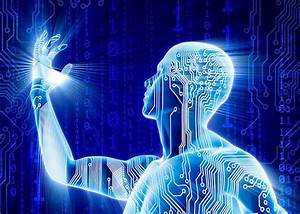
If we went back to the year 2000 and claimed that within 25 years we would be speaking daily with AI, carrying supercomputers in our pockets and training algorithms with billions of data points, it would have sounded like science fiction.
Back then, the internet screeched through dial-up connections, Netflix mailed DVDs to customers, and smartphones were not even part of our vocabulary.
Today, artificial intelligence, robotics, nanotechnology and quantum computing are advancing at an exponential pace. The real question is no longer whether the world will change by 2050 — but how radically.
The Fusion of Humans and Machines
The 2050s, as imagined by pop culture, are filled with cyber-enhanced humans. In Deus Ex (set in 2052), characters implant nanorobots into their bodies to gain superhuman abilities.
While that scenario may still be distant, the foundations already exist. Modern chips rely on billions of nanoscale transistors, and medical technology is steadily moving toward implantable devices capable of monitoring vital signs in real time.
Cybernetics professor Kevin Warwick, who in 1998 implanted a microchip into his own nervous system, predicts that treatments such as deep brain stimulation could replace pharmaceutical therapies for certain conditions.
Meanwhile, Roger Highfield, director of the Science Museum, speaks of “digital twins” — virtual replicas of ourselves that could simulate medical treatments or lifestyle changes before they are applied in real life.
The result? The boundaries between biology and electronics may become significantly blurred by mid-century.
The Next Generation of AI and the Quantum Leap
Artificial intelligence will not merely be a tool — it will be infrastructure.
Companies such as Google and IBM are investing heavily in quantum computing, a field that promises breakthroughs in data processing, pharmaceutical research and complex system simulations.
Jensen Huang, CEO of Nvidia, has stated that practical quantum applications could emerge within the next two decades.
Education may undergo an equally dramatic transformation. AI tutors that adapt in real time to each student’s learning pace, immersive mixed-reality environments and the analysis of biometric data for full personalization could redefine how knowledge is delivered.
Traditional textbooks? They may give way to interactive simulations.
Autonomous Vehicles and the Space Economy
In transportation, autonomous vehicles promise a sharp reduction in accidents and congestion. Cars will communicate with each other in real time, braking simultaneously and traveling at minimal distances apart.
At the same time, the space economy is accelerating. A permanent base on the Moon within the next few decades is no longer considered pure science fiction. Microgravity could be leveraged for the production of pharmaceuticals and advanced materials with properties impossible to achieve on Earth.
By 2050, industry may no longer be confined to our planet.
From Sci-Fi to Reality
The film Minority Report by Steven Spielberg, based on the work of Philip K. Dick, depicted a world where technology predicts crimes before they happen. Today, debates around AI ethics, surveillance and data governance are more relevant than ever.
History shows that science fiction often serves as a blueprint for the future. The critical question is not only what we will be able to build by 2050 — but how we choose to use it.
As Philip K. Dick once wrote, science has saved more lives than it has taken. And that may remain the most important reminder in an era of exponential technological change.