
A new study published in the Journal of African Earth Sciences confirms a series of recent studies suggesting that Africa is breaking apart and provides new evidence for this striking geological phenomenon.
A few months ago, a research team led by scientists from Swansea University presented a study describing a giant rift stretching across Africa from the northeast to the south. According to the researchers, this rift could eventually split the continent, leaving East Africa with its own coastline separated from the rest of the continent. Ultimately, Africa would become two pieces divided by a new ocean.
Researchers from Keele University in the United Kingdom have revisited this issue, confirming that Africa is indeed splitting in two and that the separation likely began tens of millions of years ago.
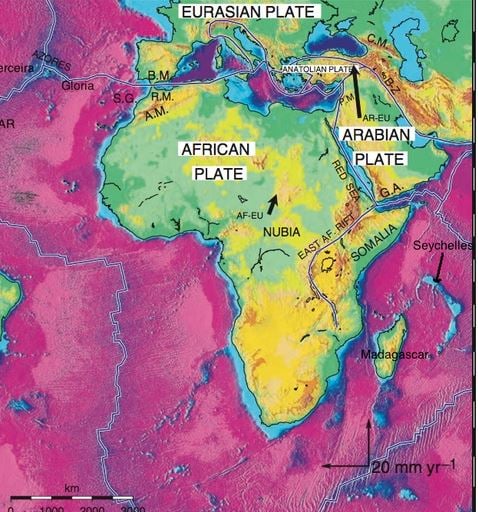
The researchers reached their conclusions by studying magnetic data, which indicate geological separation between Africa and Arabia. These two landmasses were once joined like puzzle pieces, but a gradual process pulled them apart. This separation cuts through Africa from northeast to south, resembling a zipper, accompanied by volcanic and seismic activity.
When the process is complete, in five to ten million years, Africa will consist of two continents. The larger, western portion will include countries such as Egypt, Algeria, Nigeria, Ghana, and Namibia, while the smaller, eastern portion will include Somalia, Kenya, Tanzania, Mozambique, and much of Ethiopia.
“These findings provide a unique perspective on how our planet is constantly changing and evolving beneath our feet,” said Professor Peter Styles, a geologist at Keele University.
The Plates
Plate tectonics theory shows that the arrangement of continents in the past was very different. Millions or even billions of years ago, larger tectonic plates broke apart and drifted away, creating new oceanic crust and the oceans we know today through the process of seafloor spreading.
The researchers refer to the East African Rift, one of Africa’s most significant tectonic features, caused by the fracturing of the Earth’s crust. It is approximately 6,400 km long, 5–7 km wide, and extends from Jordan to Mozambique. It is estimated that when Africa splits, the gap will follow the length of this rift, passing through vast lakes such as Lake Malawi and Lake Turkana.
For the study, scientists focused on the Afar region, where the Red Sea meets the Gulf of Aden. This area is one of the rare points on Earth where three tectonic rifts converge, forming a “triple junction.” Many scientists believe this is where the earliest stages of the separation that has already begun can be observed.
The research relied on magnetic data collected in 1968–69 using airborne instruments. By combining the old data with modern technology, the team uncovered new evidence regarding the crust’s magnetic field. They used data from scanners that study the magnetic properties of the crust in underwater mountain ranges. When the Earth’s magnetic poles reverse, they leave magnetic “signals” in the crust, similar to tree rings or barcodes.
The analysis revealed ancient “stripes” of seafloor spreading between Africa and Arabia, indicating that the separation began tens of millions of years ago. The strong magnetic signal is evidence of slow but continuous tectonic fracturing, during which the crust stretches and thins until it cracks, signaling the birth of a new ocean.
The Rate
The separation progresses so slowly that it is imperceptible to humans. According to Dr. Emma Watts, a geochemist at Swansea University, the rate is 5–16 millimeters per year in the northern part of the rift. “The process will take several million years to complete,” Watts says.
With the new study, the magnetic data from the 1968 research have been “revived from an unjustified obscurity,” the researchers note, adding that these techniques will help achieve a deeper understanding of the region’s evolution and the early stages of ocean formation.