

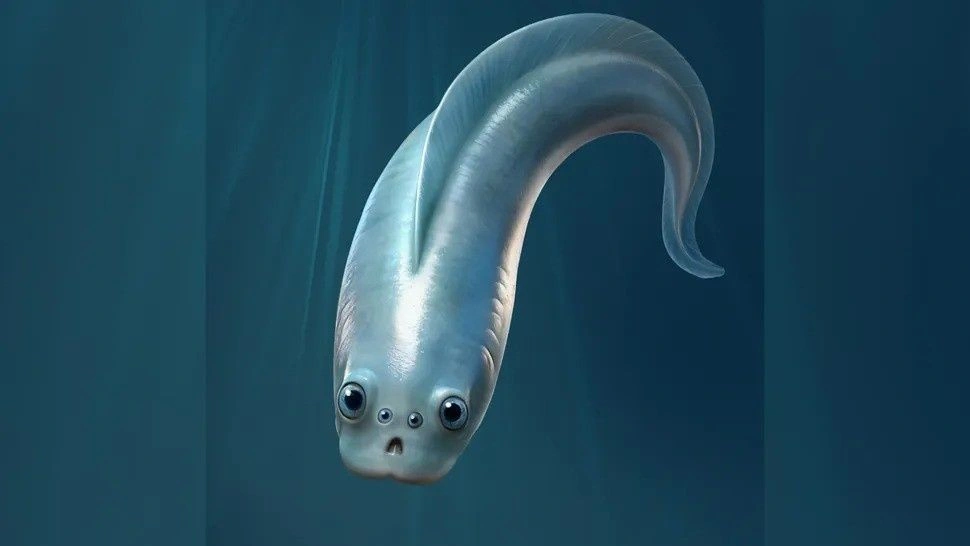
Fossil remains dating back more than 500 million years indicate that the earliest known vertebrate ancestors possessed not two but four functional eyes. This anatomical feature is thought to have provided an evolutionary advantage in increasingly competitive and predator-rich marine environments.
The discovery is based on exceptionally rare fossils found in China, attributed to early jawless fish of the genus Myllokunmingia. These organisms lived approximately 518 million years ago during the Cambrian period — a time of rapid biological diversification and the emergence of the first large predators. Within this dynamic evolutionary context, enhanced visual capacity likely played a crucial role in survival.
Four Functional Eyes
The study examined remarkably well-preserved fossils from the Chengjiang deposits in southern China. Analyses revealed that two species — Haikouichthys ercaicunensis and another unnamed species of the same genus — possessed four eyes: two larger lateral eyes and two smaller centrally positioned ones.
The preservation of soft tissues such as eyes is extremely rare in the fossil record, making these specimens particularly significant. Microscopic and chemical analyses confirmed that all four structures contained components consistent with functional vision, including lenses and light-absorbing pigments.
The presence of two additional eyes likely expanded the visual field, improving the organisms’ ability to detect predators.
The findings, published in Nature, challenge the traditional view that early vertebrates possessed only simple sensory systems, suggesting instead a higher degree of neuro-sensory complexity during the Cambrian.
Evolutionary Origins of the Pineal Gland
The study further proposes that the second pair of eyes may represent the evolutionary precursor of the so-called parietal or “third” eye — a light-sensitive structure still present in some modern fish, reptiles, and amphibians. In humans and most vertebrates, the corresponding evolutionary remnant is the pineal gland, a small endocrine structure in the brain that regulates circadian rhythms through the secretion of melatonin.
Researchers suggest that roughly half a billion years ago, this structure functioned as a fully developed image-forming eye. Over evolutionary time, it underwent structural and functional transformation, ultimately assuming its current role in regulating the sleep–wake cycle.