

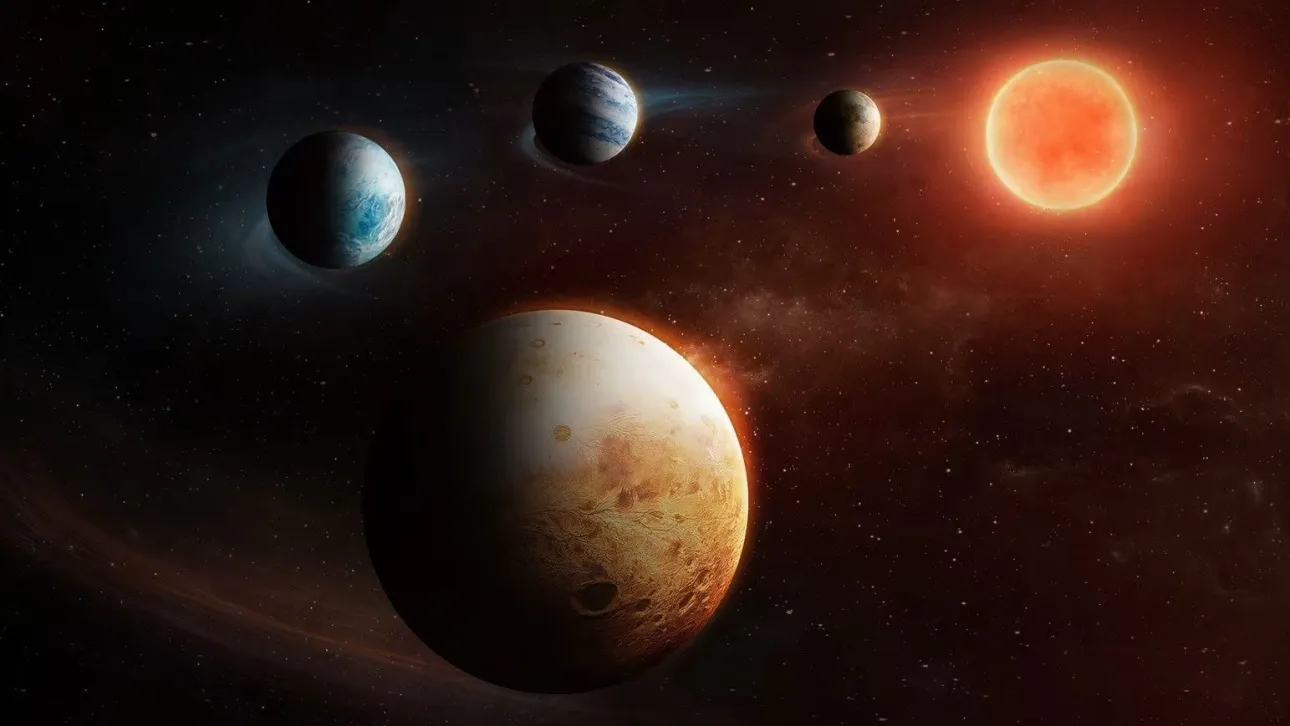
An exoplanetary system located approximately 116 light-years from Earth appears to challenge established models of planet formation. According to a recent study based on observations from space- and ground-based instruments operated by NASA and the European Space Agency, four planets orbiting LHS 1903 — a low-mass red dwarf — exhibit a configuration that departs from the prevailing theoretical framework.
Specifically, the innermost planet is rocky in composition, followed by two gas-rich planets, while the outermost planet is once again rocky. This arrangement reverses the pattern observed both in the Solar System and in a large number of exoplanetary systems, where rocky planets are typically found close to the host star and gas giants occupy wider orbital distances.
Theoretical Background of Planet Formation
The dominant theory holds that planets form within protoplanetary disks of gas and dust surrounding young stars. In the inner regions of these disks, where temperatures are high, volatile compounds — such as water and carbon dioxide — remain in gaseous form. By contrast, materials with high melting points, including silicate minerals and iron, can condense into solid grains, ultimately leading to the formation of rocky planets.
Beyond the so-called “snow line,” where temperatures are low enough for volatile compounds to condense into ice, the available solid mass increases substantially. This facilitates the rapid growth of planetary cores. Once a forming core exceeds roughly ten Earth masses, its gravitational pull becomes strong enough to accrete large quantities of hydrogen and helium, potentially triggering runaway gas accretion and the formation of gas giants.
The Outer Rocky Planet as a Theoretical Challenge
In the LHS 1903 system, the outermost planet, LHS 1903 e, has a radius approximately 1.7 times that of Earth and is classified as a “super-Earth,” meaning a planet with greater mass but comparable density and potentially similar composition to our own. The presence of such a rocky body in an արտաքին orbit, beyond two gas-rich planets, is not readily explained by simplified versions of the core accretion model.
The study, published in the journal Science and led by Thomas Wilson of the University of Warwick, suggests that the planets in this system may have formed during temporally and environmentally distinct phases of the protoplanetary disk’s evolution. One possible interpretation is that the outer rocky planet formed at a later stage, when the available gas had already been significantly depleted, thereby limiting further gaseous accretion.
Implications for Planetary Architecture Models
This discovery indicates that planetary system architectures may result from more complex and dynamic processes than those described in classical formation models. Mechanisms such as planetary migration, temporal changes in disk structure, and gravitational interactions among planetary bodies may play a decisive role.
The LHS 1903 system thus provides a valuable natural laboratory for investigating the diversity of planetary configurations within the Galaxy, prompting the scientific community to reassess fundamental assumptions about the formation and evolution of planetary systems.