

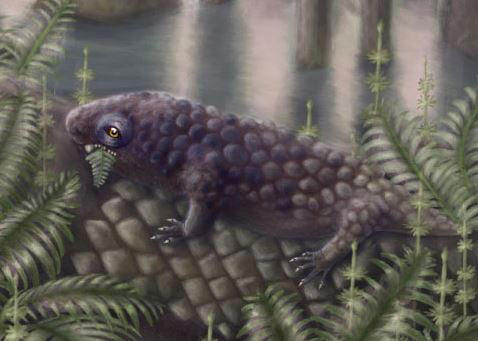
A 307-million-year-old fossil is offering new insights into one of the most pivotal moments in the history of life: the transition from sea to land — and the emergence of the first plant-eating vertebrates.
The animal, named Tyrannoroter heberti, represents a new species of “microsaur” from the Carboniferous period (359–299 million years ago), an era marked by vast forests, high oxygen levels, the dominance of amphibians, and giant insects. The forests of that time eventually formed the massive coal deposits we rely on today.
The discovery, published in Nature Ecology and Evolution, reveals that some of the earliest land-dwelling vertebrates had already evolved complex teeth capable of chewing plant material. This suggests that herbivory on land appeared much earlier than previously believed — almost immediately after animals made the move from water to land.
A Small Animal with Big Significance
Tyrannoroter heberti lived in what is now Canada around 307 million years ago. Its fossilized skull was discovered on Cape Breton Island in Nova Scotia.
At roughly 30 centimeters (about one foot) in length, it was — according to researchers — about the size and shape of an American football. By today’s standards it was not especially large, but for its time, it was among the bigger animals roaming the land.
Thanks to a detailed 3D reconstruction of the skull, scientists were able to examine its internal structures and uncover specialized teeth designed for processing plant matter. It is the first member of its group to undergo such an in-depth digital reconstruction, allowing researchers to trace the early origins of terrestrial herbivory.
“It is one of the oldest known tetrapods to eat plants. It shows that experimentation with herbivory began very early among the ancient relatives of all land vertebrates — including us,” said Dr. Arjan Mann of the Field Museum.
Before Reptiles and Mammals
Externally, it likely resembled a lizard. However, it lived before the evolutionary split that gave rise to reptiles and mammals, meaning it technically belonged to neither group.
Tyrannoroter heberti is part of the Pantylidae, an extinct family of small tetrapods with amphibian-like features. Scientists classify them as “stem amniotes” — animals closely related to the earliest amniotes, the tetrapods that evolved eggs capable of developing outside water.
This evolutionary innovation paved the way for full independence from aquatic environments and, later, for the divergence into reptiles and the early ancestors of mammals.
“Until recently, herbivory was thought to be restricted to amniotes. Yet Tyrannoroter heberti, although a stem amniote, already possesses specialized dentition for processing plant material,” noted Dr. Hans Sues of the Smithsonian’s National Museum of Natural History.
From Insects to Plants
Its diet likely did not consist exclusively of plants. Scientists suggest it may also have consumed insects. The tough exoskeletons of insects could have “trained” the jaws and teeth of early tetrapods to crush resistant materials — an evolutionary stepping stone that later facilitated the chewing of plants.
Moreover, feeding on plant-eating insects may have provided early tetrapods with the gut microbes necessary for digesting plant matter — a subtle but crucial adaptation.
A Lesson from Ancient Climate Change
At the end of the Carboniferous period, tropical forests collapsed and the planet entered a phase of global warming. The evolutionary lineage to which Tyrannoroter heberti belonged did not fare well.
Yet its story offers a striking parallel to the present. As researchers point out, the fate of early herbivorous tetrapods may help us understand how ecosystems — and the animals that depend on them — respond when climate change rapidly transforms vegetation and habitats.
A small animal from deep geological time thus reminds us that evolution, adaptation, and climate change have always been tightly intertwined — and that major ecological upheavals invariably leave their mark on life on Earth.