

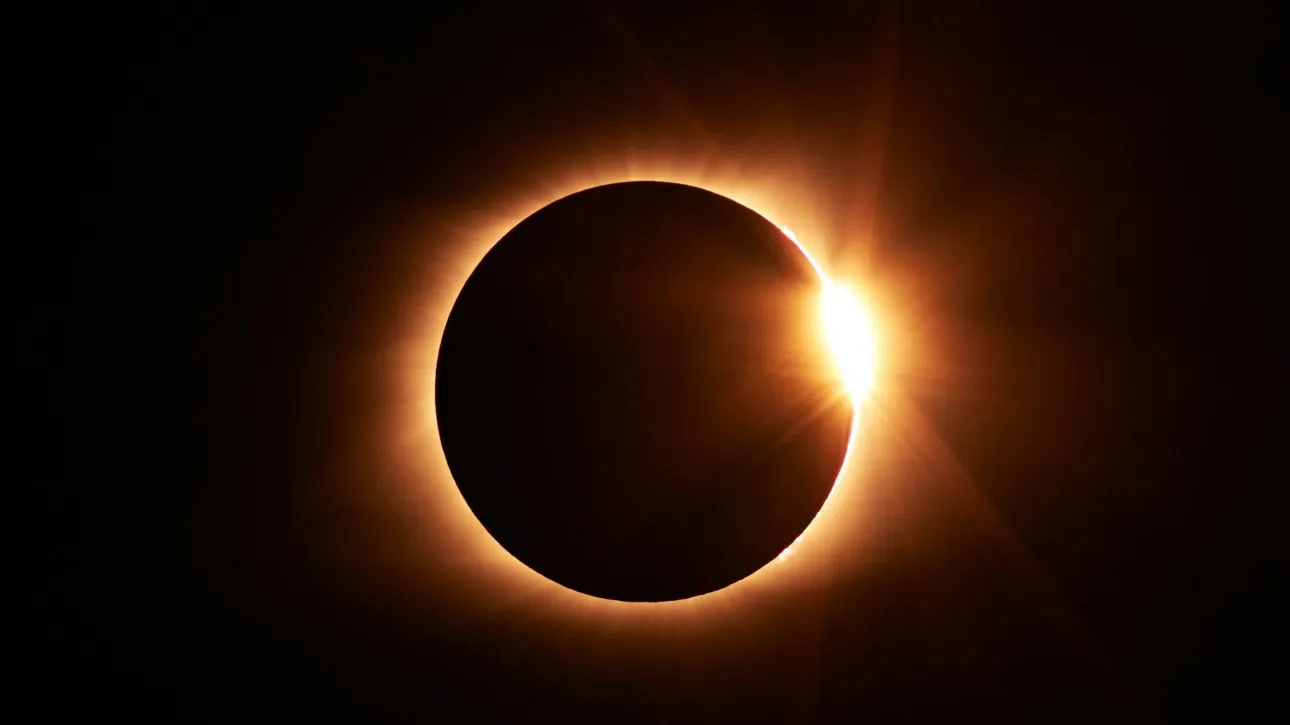
On August 2, 2027, the planet will witness the most spectacular total solar eclipse of the 21st century, as daylight will vanish for a few minutes across vast regions of Europe, North Africa, and the Middle East.
Astronomers note that the total phase of the eclipse will last approximately six minutes — an exceptionally rare duration, considering that most total eclipses only last two to three minutes. In fact, an event of this scale is not expected to occur again until the 22nd century.
The countdown has already begun among amateur and professional astronomers, along with the race to secure the best observation points, as bookings for flights and hotels surge.
Bigger Moon, Smaller Sun: A Rare Cosmic Alignment
The uniqueness of this eclipse lies in a near-perfect alignment of astronomical factors. The Moon will be near its perigee — the closest point to Earth in its orbit — making its dark disc appear slightly larger in the sky. At the same time, Earth will be near aphelion, its farthest point from the Sun, causing the solar disc to appear slightly smaller.
This combination will allow the Moon to fully cover the Sun, producing a prolonged period of total darkness and turning the eclipse into a must-see event for “eclipse chasers.”
The path of totality will begin over the Atlantic Ocean, pass through the Strait of Gibraltar — affecting southern Spain and Morocco — and continue across North Africa, including Algeria, Tunisia, Libya, and Egypt, before ending in Saudi Arabia and Yemen.
According to kpubs.org, the maximum totality, lasting 6 minutes and 23 seconds, is expected near Luxor, Egypt.
There, the iconic archaeological sites of the Valley of the Kings will be plunged into complete darkness for several minutes, creating a once-in-a-lifetime scene for both science and photography.