

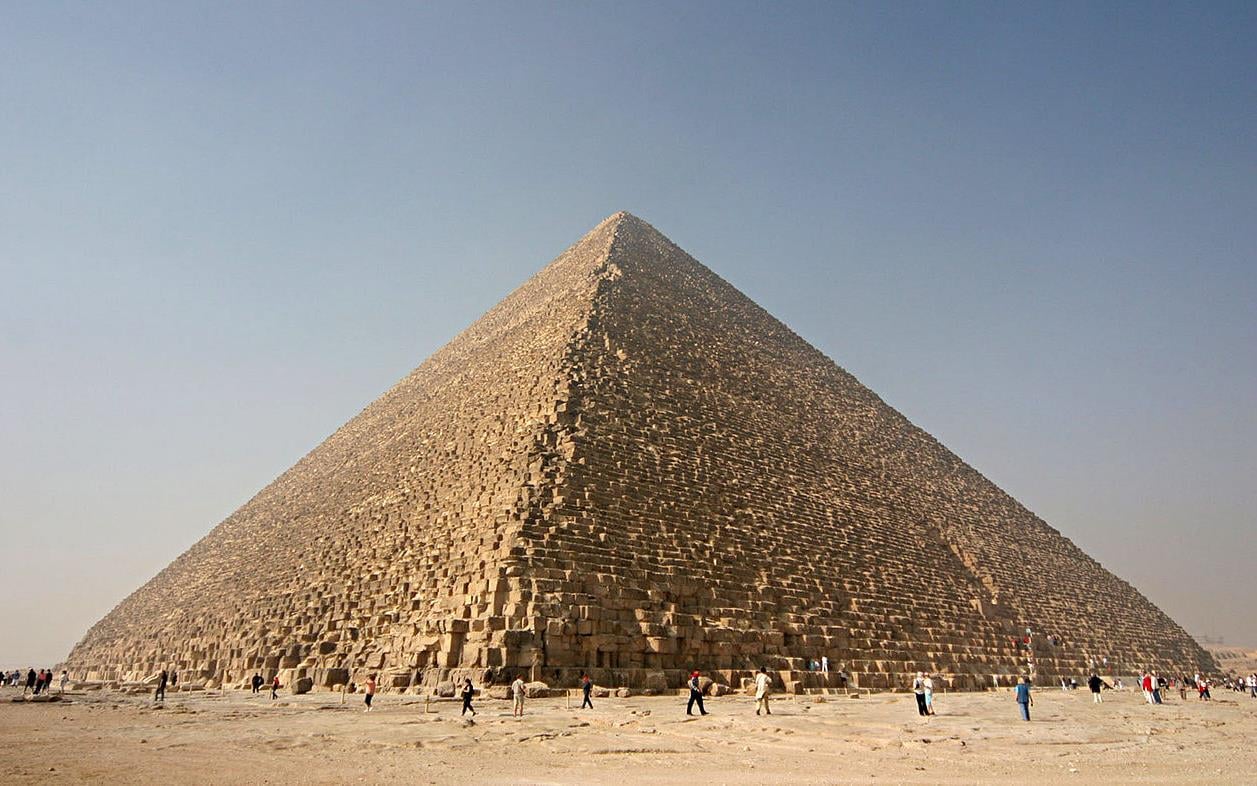
The construction of the Great Pyramid of Egypt has long puzzled archaeologists, as no ancient texts have survived explaining how its massive stone blocks were lifted and assembled so quickly.
The Pyramid of Khufu (also known as the Great Pyramid of Giza) is the oldest and largest of the three pyramids in the Giza Necropolis. It is the oldest of the Seven Wonders of the Ancient World and the only one that survives today. It is also a UNESCO World Heritage monument.
With a height of 146.5 meters, it was the tallest structure in the world for more than 3,800 years. Originally, the Great Pyramid was covered with casing stones that created a smooth, even outer surface. What we see today is the underlying core structure. Traditional theories rely on ramps and slow, layer-by-layer construction, but they struggle to explain how stones weighing up to 60 tons were lifted to heights of dozens of meters.
A new study now proposes that the pyramid was built using an internal system of counterweights and pulley-like mechanisms hidden within its structure.
The researchers, who published their study in the journal Nature, calculated that builders could have lifted and placed massive stone blocks at an impressive rate—possibly even one block per minute. They argue that this would only have been possible through the use of sliding counterweights, rather than sheer human strength, as such systems could generate the necessary power to raise stones to the upper levels of the Pyramid of Khufu.
The model
The study also highlights architectural features inside the pyramid that support this model. The researchers reinterpret the Ascending Passage and the Grand Gallery as internal construction ramps along which counterweights could descend, generating lifting force.
The Antechamber, long thought to be a defensive or security feature, is reinterpreted as a pulley-like mechanism capable of helping lift even the heaviest stones. If this theory is correct, the Great Pyramid was built “from the inside out,” starting with an internal core and using concealed pulley systems to raise stones as the structure grew.
According to the new study, heavy counterweights slid downward along inclined internal corridors, creating force that lifted stones elsewhere within the core. The researchers suggest that grooves, wear marks, and polished surfaces on the walls of the Grand Gallery are evidence that large sleds repeatedly moved along it, indicating mechanical stress consistent with sliding loads rather than simple human passage or ritual use.
The study also offers a new interpretation of the Antechamber, a small granite space just before the King’s Chamber. Traditionally viewed as a security mechanism to deter tomb robbers, it is presented here as a pulley-based lifting station.
Grooves cut into the granite walls, stone supports that may once have held wooden beams, and unusually rough workmanship suggest a functional machine rather than a finished ceremonial space. In the researchers’ model, ropes would have passed over wooden rollers placed in the Antechamber, allowing workers to lift stones weighing up to 60 tons. The system could be adjusted to increase lifting power when needed, similar to changing gears.
The shaft and constraints
Oversized rope grooves and an uneven, inset floor suggest that the space was once connected to a vertical shaft that was sealed after construction was completed. Beyond individual chambers, the researchers argue that the pyramid’s entire internal layout reflects engineering compromises rather than symbolic design.
The main chambers and passages are clustered near a common vertical axis but are oddly offset rather than perfectly centered. The Queen’s Chamber, for example, is centered north–south but not east–west, while the King’s Chamber lies noticeably south of the pyramid’s central axis.
Such asymmetries are difficult to explain if the pyramid had been built uniformly from the ground up using external ramps. In a traditional model, builders could have placed the chambers wherever they wished with perfect symmetry. Instead, the offsets suggest that they were working around mechanical constraints imposed by internal lifting systems.
The theory also offers explanations for enigmatic external features, such as the slight concavity of the pyramid’s sides and the complex pattern by which the height of the stone layers gradually changes. According to the researchers, these features may reflect shifts in internal ramps and lifting points as the pyramid rose and as stones at higher levels became lighter.
The predictions
Importantly, the model makes testable predictions, arguing that there are no large unknown chambers hidden within the pyramid’s core—an idea supported by recent muon-scanning studies. However, smaller corridors or remnants of internal ramps may still exist in the outer parts of the structure, particularly at higher levels.
If confirmed by future discoveries, the researchers’ proposal could radically change how archaeologists understand not only the Great Pyramid, but pyramid architecture throughout ancient Egypt.