

Greenland is changing, as centuries of ice accumulation and its ongoing melting are causing shifts in its underlying foundations. According to researchers, this deformation could have a profound impact on how navigation in the region will be carried out in the future, in a world with ever less ice.
Led by the Technical University of Denmark (DTU), an international team of scientists analyzed data from 20 years of GPS measurements, tracking 58 specific locations across Greenland. The data show that as the land moves northwest at a rate of about two centimeters per year, some areas are expanding while others are contracting, reports Science Alert.
How Greenland’s ground is changing
Three geological forces affect Greenland’s portion of the Earth’s crust: the movement of tectonic plates, the reduction of pressure in the subsurface due to the melting of present-day glaciers, and the very long-term rebound continuing from the last Ice Age, known as Glacial Isostatic Adjustment.
By using a combination of data from GPS stations across Greenland, computational models, measurements from several thousand other GPS stations in North America, and calculations of movements spanning the past 26,000 years, the team was able to isolate these three factors.
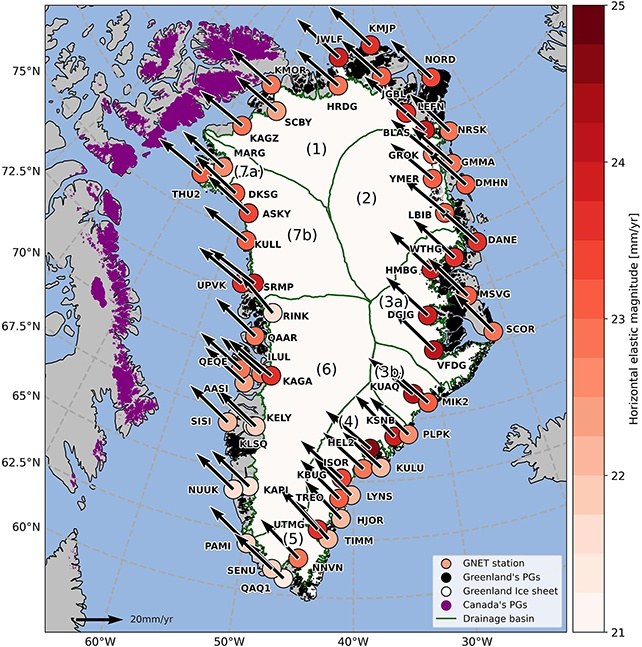
Monitoring of 58 locations shows that Greenland is moving northwest (Berg et al., Journal of Geophysical Research: Solid Earth, 2025). This enabled researchers to record Greenland’s movements with the greatest accuracy to date, particularly its horizontal displacement. Their study, published in the journal Journal of Geophysical Research: Solid Earth, could improve future models of Greenland’s motion and our understanding of how the planet is likely to respond to the ongoing impacts of climate change.
Significant implications
When such large masses of ice are added to or removed from the Earth’s surface, the consequences can be substantial. Scientists continue to reassess the potential effects of shrinking glaciers at both poles.
Previous studies have shown that such changes could “awaken” dormant volcanoes or lead to increases in methane emissions due to the gradual “greening” of polar regions.
Continued data collection and analysis could help improve estimates of changes in Greenland’s shape. “It is important to understand the movements of continental landmasses,” says geophysicist Danjal Longfors Berg of DTU. “They are not only of geoscientific importance but are also critical for mapping and navigation, as even supposedly fixed reference points in Greenland are slowly moving.”