

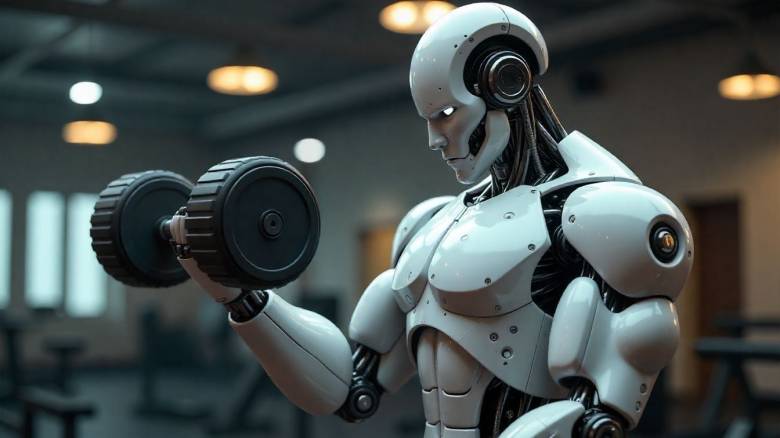
Researchers in South Korea have developed an artificial muscle capable of lifting approximately 4,400 times its own weight, which they say could be used in future humanoid robots.
A major innovation in its design is the artificial muscle’s ability to be either flexible or rigid when needed, a first in this field of research. The scientists presented their findings in a study published in the scientific journal Advanced Functional Materials.
“This research overcomes the fundamental limitation of artificial muscles, which are either extremely flexible but weak, or strong but rigid,” said lead author Hoon Eui Jeong, professor of mechanical engineering at the Ulsan National Institute of Science and Technology (UNIST). “Our composite material can achieve both, paving the way for more versatile soft robots, wearable devices, and more natural human–machine interfaces.”
Flexibility and strength
Artificial muscles have long faced the challenge of combining flexibility and strength, reports LiveScience. They must be elastic while also capable of delivering sufficient energy to achieve high work density (the amount of energy produced per unit volume).
Soft artificial muscles are considered revolutionary because they are lightweight, mechanically compatible, and capable of multidirectional movement.
The new achievement by the Korean scientists is described as a “high-performance magnetic composite actuator.” It is a complex mixture of polymers bonded together to mimic muscle contraction and relaxation. One of the polymers has a variable stiffness and is embedded within a mesh containing magnetic microparticles on its surface, which can also be controlled. This allows the muscle to move and be controlled through adjustable stiffness.
1.13 grams of muscle can lift 5 kilograms
The result is an artificial muscle that becomes rigid when it needs to bear weight and soft when it needs to contract. In its rigid state, the muscle, weighing just 1.13 grams, can support up to 5 kilograms — about 4,400 times its own weight. At the same time, it demonstrates impressive elasticity: while human muscle contracts by about 40%, the synthetic muscle reaches 86.4%, more than double. This translates into a work density of 1,150 kilojoules per cubic meter — 30 times higher than that of human tissue.