

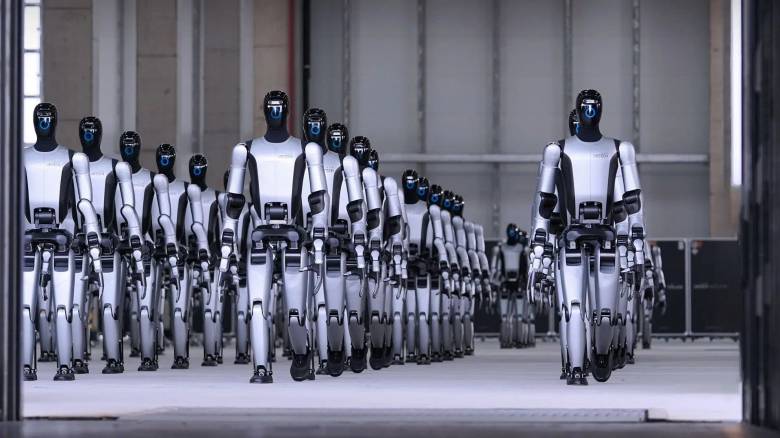
China is deploying humanoid robots to guard its borders. UBTech Robotics has recently secured a government contract worth 264 million yuan – around €32 million – to deploy robots along the border between the Guangxi region and Vietnam.
The agreement involves the installation of industrial humanoid robots at key border locations, with the aim of supporting patrols and guiding travelers. To implement the project, the Walker S2 model will be used, which UBTech unveiled in July. Walker S2 is considered the world’s first humanoid robot capable not only of navigating and perceiving its surroundings, but also of autonomously replacing its own batteries.
The official operational deployment of the robots is expected to begin this month. In the initial phase, the humanoids will mainly carry out routine tasks, such as surveillance patrols and basic support at checkpoints. The agreement forms part of a broader strategy by the Chinese government to promote the large-scale commercial use of artificial intelligence, with the robotics industry benefiting from strong state funding.
Plans for other uses
However, the ambitions extend beyond border security. Government and technology circles are considering expanding the use of humanoids into areas such as heavy industry, copper and steel production, as well as security at major public events, concerts and sporting competitions.
Experts estimate that in the near future humanoids could take on demanding surveillance duties in areas where human presence is dangerous or practically impossible, such as remote mountainous regions or high-risk environments. At the same time, their use in environmental monitoring missions or emergency situations is also being discussed.
Despite concerns raised by the rapid automation of security, Chinese authorities emphasize that the goal is not to replace human personnel, but to reduce risks and operational constraints while increasing efficiency.