

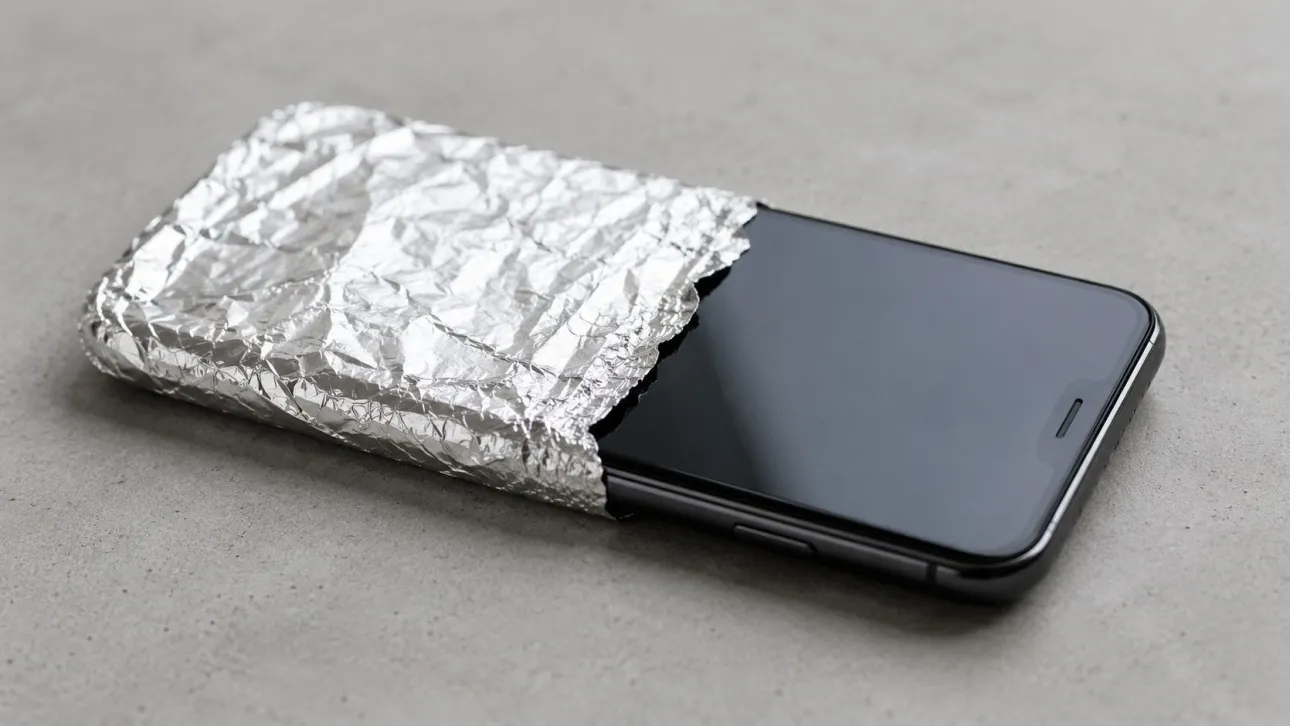
Aluminum foil may be a kitchen staple, but some people use it for a very different purpose: as a makeshift barrier against the wireless signals emitted by a smartphone.
In an age when mobile phones remain almost constantly connected to cellular networks, Wi-Fi, Bluetooth and location services, temporarily isolating a device may sound unusual. Yet the practice is based on a genuine principle of electromagnetic physics.
The Faraday cage effect
The explanation lies in what is known as a Faraday cage. A conductive metal enclosure can limit or weaken the passage of electromagnetic signals through it.
When a smartphone is sufficiently covered with aluminum foil, electromagnetic waves used for wireless communication can be significantly weakened. Part of the signal’s energy is reflected by the conductive surface, reducing the strength that reaches the device inside.
As a result, if the coverage is sufficiently complete, communication with cellular networks, Wi-Fi, Bluetooth or GPS can be disrupted. The effect is not absolute, however, and depends on factors such as the frequency of the signal and how thoroughly the device has been enclosed.
Why would anyone do it?
One reason is to temporarily isolate a phone from wireless networks and location-related services. When a device cannot communicate with external networks, its ability to maintain those wireless connections is correspondingly reduced.
The technique may also be of interest in situations where limiting wireless communications is desirable. The metal barrier can also interfere with short-range technologies such as NFC and RFID.
There is an even simpler reason, however: temporarily disconnecting from the digital world. A smartphone without network access cannot receive the usual notifications, messages and other online updates.
Can it help preserve battery life?
Under certain conditions, cutting off network access may reduce the phone’s repeated attempts to search for an available signal. This could have some effect on battery consumption, particularly in areas with extremely weak or nonexistent cellular coverage.
Still, aluminum foil is hardly a practical alternative to the phone’s built-in settings. For everyday use, Airplane Mode or manually disabling specific wireless connections is a much simpler approach.
Why it is not a permanent solution
Despite its ability to block signals under certain conditions, aluminum foil is not designed to serve as a permanent protective enclosure for a smartphone.
A phone may continue using power while attempting to find a network, while wrapping the device in material that restricts heat dissipation could potentially contribute to higher temperatures.
There is another practical consideration as well: a fully isolated smartphone may be unable to make or receive an important communication.
A simple experiment based on physics
Wrapping a smartphone in aluminum foil is neither a secret trick nor a sophisticated cybersecurity solution. It is essentially a simple demonstration of a well-established principle of physics.
What makes it interesting is that such an ordinary household material can, under the right conditions, interfere with the connectivity of one of the most connected devices in modern life.