
A groundbreaking laser imaging technique is enabling scientists to detect and map microplastics inside living organisms without the need for surgery, biopsies, or tissue sampling, offering a powerful new tool for studying the health effects of plastic pollution.
Microplastic particles have already been found in oceans, fish, food, drinking water, clothing, and even the air we breathe. Until now, however, tracking their accumulation inside the body largely relied on invasive procedures and post-mortem tissue analysis.
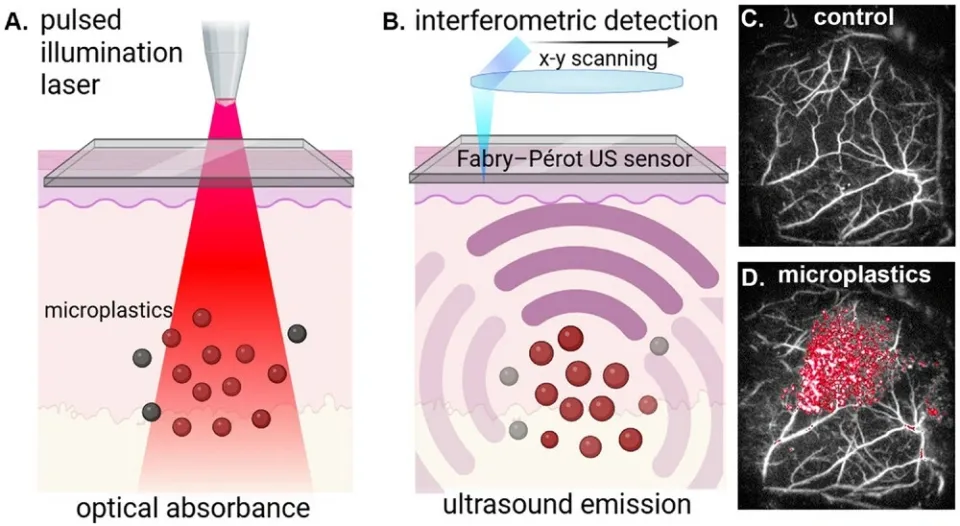
The new approach is based on photoacoustic imaging, a technology that combines light and sound. Laser pulses are directed into biological tissues, where they are absorbed by microplastic particles. This absorption generates tiny high-frequency sound waves that can be detected and converted into detailed images showing the exact location of the particles.
Researchers say the method allows long-term monitoring of microplastics within the body, revealing where they accumulate, how long they remain in tissues, and how they move through biological systems over time.
Dr. Steven Patrick of University College London, who led the study, noted that people are exposed to microplastics every day through food, beverages, clothing, and household products. As concerns grow over the potential health impacts of these particles, scientists have been searching for more effective ways to study their behavior in living tissues.
According to the research team, the new technique could help answer critical questions about whether microplastics contribute to diseases affecting the brain, blood vessels, and other organs, as well as provide insights into their long-term biological effects.
The study, published in the journal Advanced Science, demonstrated that the non-invasive method can detect microplastics deep within the tissues of living mice. During the experiments, researchers injected a small quantity of microplastic particles and tracked their movement throughout the body over an extended period.
Among the materials identified were polypropylene, commonly used in food containers and disposable coffee cups, and polyethylene, a plastic widely found in shopping bags and single-use products.
Unlike conventional methods that require chemical labeling of plastic particles before tracking them, the new system can identify microplastics directly without altering their natural behavior. Scientists believe the technology could also be applied to the study of plastic-based medical implants, helping researchers monitor their performance, durability, and potential side effects over time.