

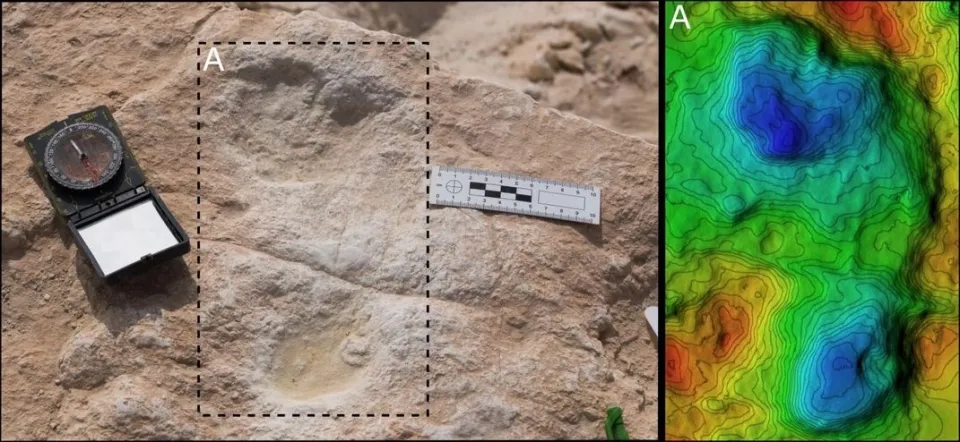
A remarkable archaeological discovery in northern Saudi Arabia has revealed human footprints dating back around 115,000 years — in a location where such early presence was not expected.
The seven footprints were found among hundreds of animal tracks in the An Nafud Desert, at a site named Alathar, meaning “trace” in Arabic. The area was once the muddy shore of a lake that likely served as a passageway for humans and animals over 100,000 years ago.
Rare preservation conditions
The footprints survived due to exceptionally rare conditions. Tracks left in mud typically degrade within days unless rapidly covered by sediment.
At Alathar, geological processes such as wind erosion later exposed the preserved surface, revealing details that are seldom retained over such vast timescales.
Who left the footprints
The key question concerns their origin. While multiple human species existed at the time, evidence points to Homo sapiens.
Researchers base this conclusion on the known expansion of Homo sapiens in the region between 130,000 and 80,000 years ago, the absence of Neanderthals in the area during that period, and the size and morphology of the footprints.
A prehistoric “highway”
The Alathar lake likely functioned as a vital migration corridor — a natural “highway” attracting both humans and large animals due to the availability of freshwater.
However, the lack of tools or butchery marks suggests only brief human presence, likely limited to short توقفs for water rather than long-term settlement.
Evidence of a changing climate
The footprints may belong to groups of Homo sapiens moving through a once greener Arabian Peninsula, before environmental conditions shifted dramatically toward aridity.
The absence of later human tracks in the same layer suggests these individuals may have been among the last to cross the region before it became inhospitable.
This discovery provides important insight into early human migration routes and highlights the Arabian Peninsula’s role as a key corridor between continents.